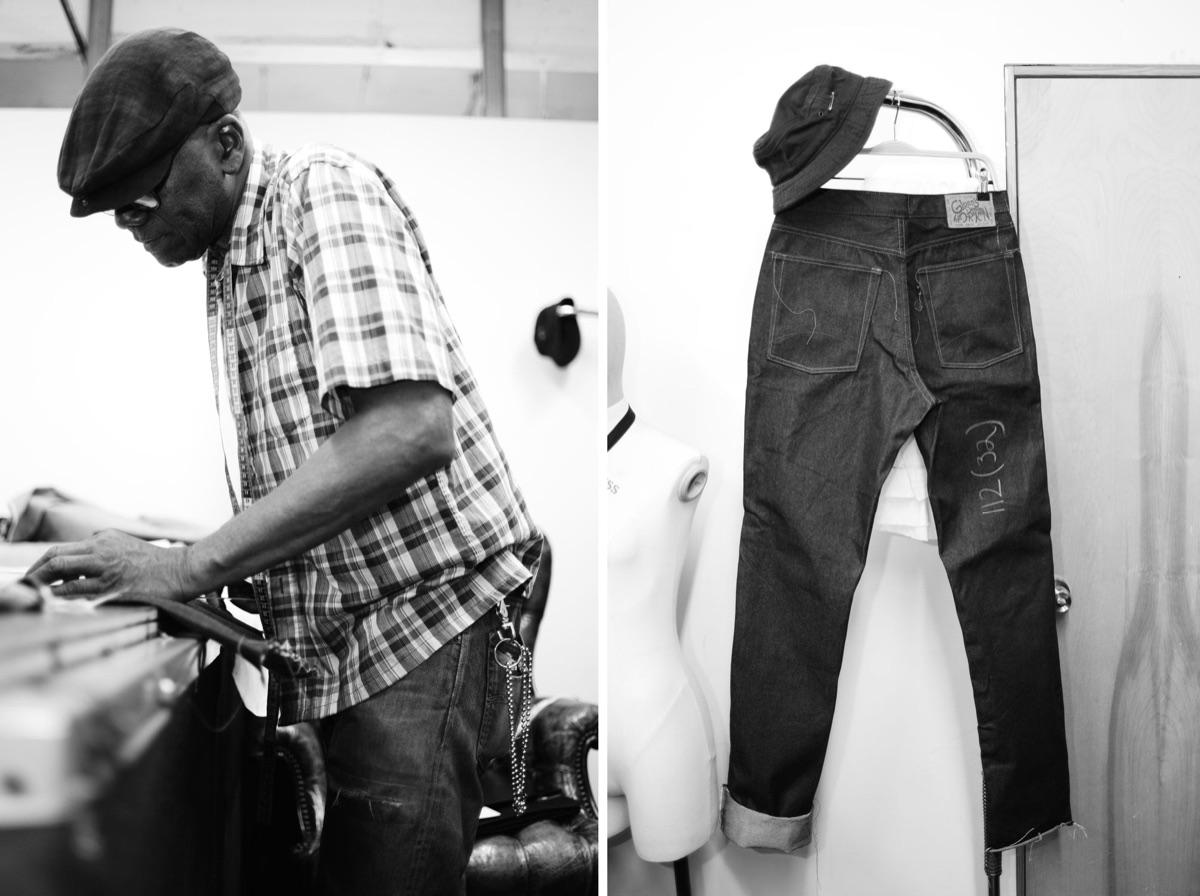
Glenn’s Denim makes raw jeans, trucker jackets, chore coats and work pants in New York City, almost all of it in denim woven in the United States. It is named for, and largely made by, Glenn Liburd, a patternmaker and tailor who grew up in Trinidad, came to New York in his forties to make jeans, spent years as the lead tailor on Levi’s made-to-order program, and launched his own collection in two thousand nineteen at the age of sixty-two. It is one of the smallest labels we have profiled, and one of the most personal.
The Jeans the Oil Workers Wore
Liburd’s mother taught him to sew on the family machine and gave him small projects to finish. As a teenager he found work in a small workroom in Trinidad that made clothes for the island’s oil field workers, mechanics and tradesmen, along with a few local designers. Some of those oil workers came home from trips to the United States in American jeans, and he tried to copy a pair. The jeans matched the clothes he saw on screen. “The blue jeans represented to me everything I wanted to be,” he has said: the cowboys, bikers and musicians of American films, and the idea that hard work and risk could add up to something.
He chose the trade over college. In his early twenties he apprenticed to a master tailor in Trinidad who had trained on Savile Row in London, starting at the bottom and working up to making suits and shirts by hand. In his mid-twenties he and a few colleagues left to open their own shop, doing bespoke tailoring, production for designers and a line of their own, denim included. He also worked in a Trinidad factory that made Maverick jeans. Through all of it the goal stayed the same. “I said, ‘Okay, if I really want to make jeans, I should make jeans in America,’” he told Heddels.
“I knew I wanted to make the world’s best jeans and do it in the country where they were born.” Glenn Liburd
The Five Hundred and First Jean
Liburd moved to New York in the early two thousands and spent the next decade working his way up in the city’s clothing trade again, making bespoke jeans on the side for customers who found him by word of mouth. Around two thousand eleven he read a newspaper story about Brooklyn Tailors, a small made-in-New York tailoring shop, and walked in to introduce himself to its co-owner, Daniel Lewis. The two became friends, and Liburd began helping the shop with patterns and alterations.
Then came the job that tested everything he knew. When Levi Strauss built Lot No. 1, its made-to-measure program for the 501, Liburd applied by sending sample jeans and was hired as its lead denim tailor in New York. He has called it a benchmark: the company that invented the blue jean asking him to make the most custom version of its most famous product. At the SoHo store it happened to be Liburd who sewed the five hundred and first pair, which the store marked with a replica of the milestone jean.
The first jeans with his own name on them came out of the friendship, not the day job. By the fall of two thousand eighteen Brooklyn Tailors was selling a Glenn’s Denim slim straight jean, sewn in Brooklyn from fourteen-ounce Cone Mills selvedge, with single-needle construction and felled seams, for about two hundred fifty-five dollars. Heddels called it serious bang for the buck. On May eighteenth, two thousand nineteen, Liburd left Levi’s, and that year he launched a full collection with Daniel Lewis on design and Lewis’s wife and business partner, Brenna Lewis, running the business side.
Five Fits and a Jacket
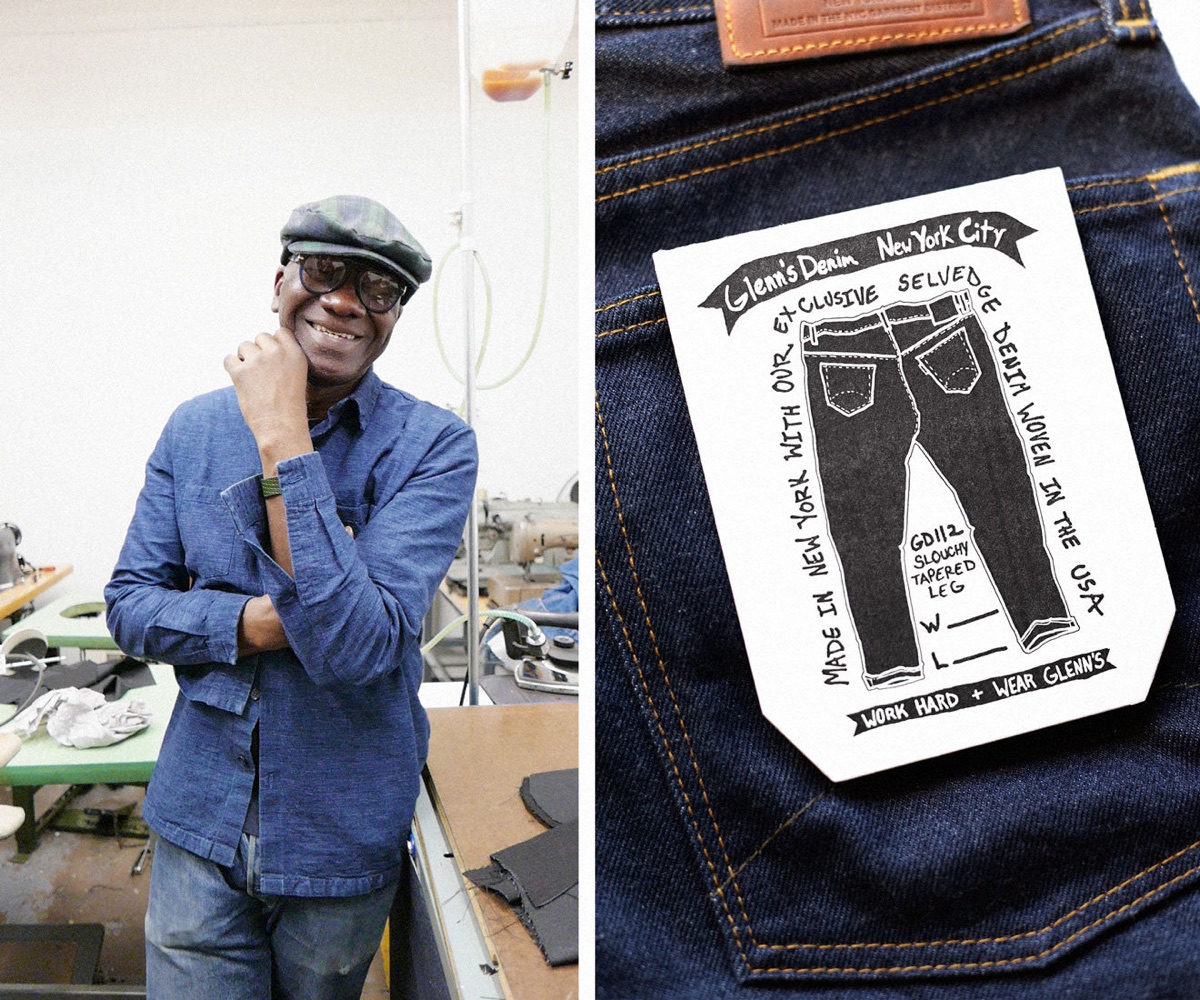
The first collection was compact and built to last: four jean fits numbered like workwear lot codes (the GD110 slim tapered, GD111 slim straight, GD112 slouchy tapered and GD113 wide leg), a slim trucker jacket, a relaxed trucker and a chore coat, in raw or washed denim, indigo or black. Brooklyn Tailors carried it first and exclusively, at two hundred ten to three hundred ten dollars. In January two thousand twenty Blue in Green, the SoHo jeans shop, commissioned an exclusive pair made by Liburd in his Brooklyn studio. No Man Walks Alone picked up the line online, and The Rake added it to its atelier collection in two thousand twenty-four. The brand now lists Bergdorf Goodman among its stockists.
What grew from there grew in the same direction. There are herringbone and black bull denim work pants with nineteen sixties deadstock vegetable ivory buttons from the Rochester Button Company, bootcut jeans, a short-sleeve shirt, a Black Label collection with seven-hundred-dollar jeans in a special-woven black denim, and, this year, women’s jeans, including a high-waisted indigo barrel jean, and a pink selvedge jean named for the flowers of the indigo plant. Much of it is made to order. The partners have said plainly that they mean to stay small. On the Blamo! podcast in two thousand twenty-one, host Jeremy Kirkland noted that the brand skips the flashy site and the comparison ads altogether.
“Every garment you make, you see where you went wrong. You just keep learning and learning.” Glenn Liburd
Starting Over at Sixty-Two
Glenn’s Denim is a late start by design. Liburd spent most of his working life making clothes that carried someone else’s name, and he walked away from a steady job at the biggest name in denim to bet on his own in his sixties. The cloth moved under him almost at once. The first jeans were built on Cone’s White Oak selvedge, and White Oak, the last big shuttle-loom selvedge mill in the country, closed at the end of two thousand seventeen. A label that had promised American denim had to find American selvedge in a country that had just about stopped weaving it.
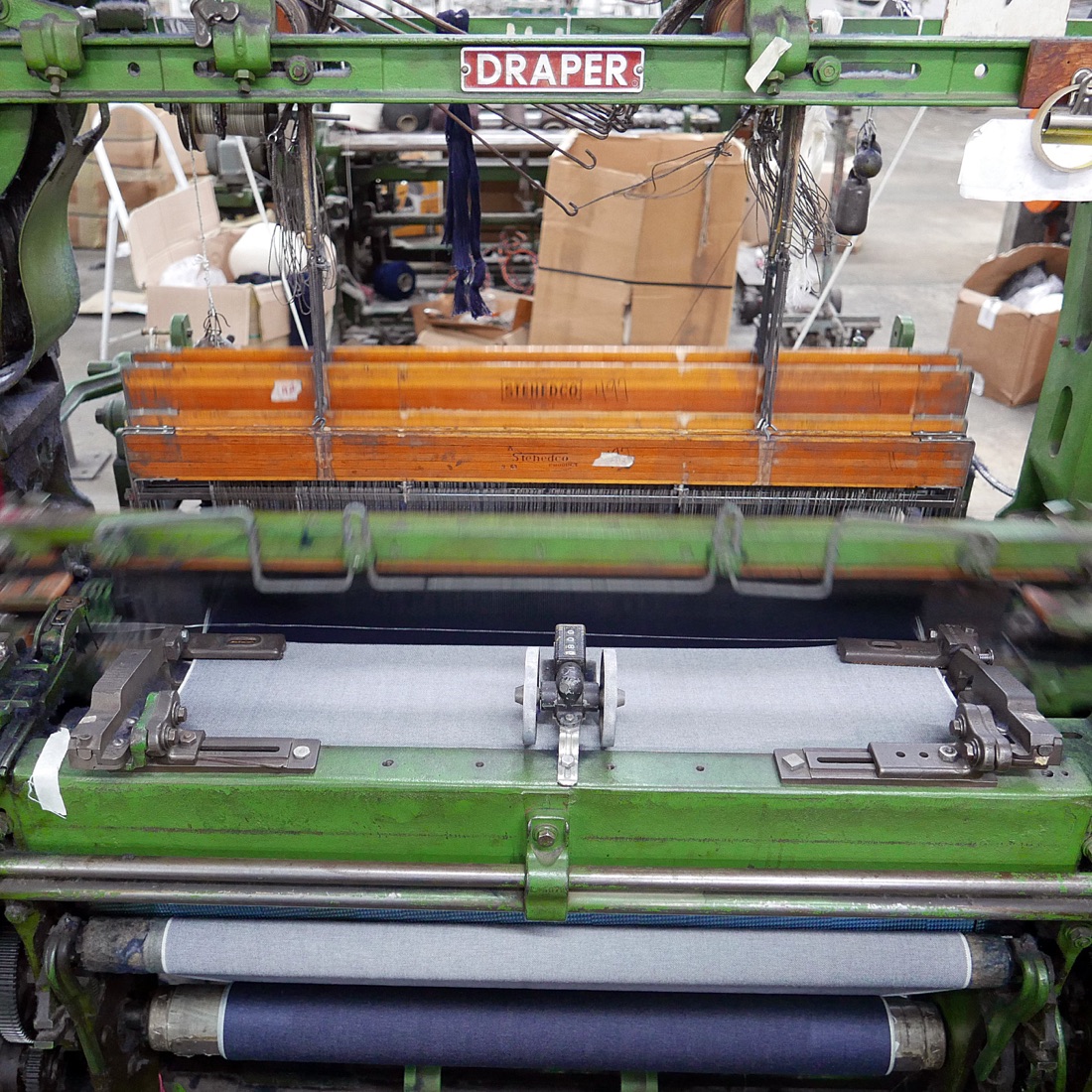
The answer was small. The brand found a small, artisanal weaver in Pennsylvania running a Draper X3 shuttle loom, the same model that filled White Oak, and began having cloth woven there in short runs, exclusive to Glenn’s, finished with a green and white selvedge ID. It comes in very limited batches. For a lower price point it buys from a different kind of mill: what it describes as the one major denim weaver left in the United States, in Georgia, weaving on modern wide projectile looms. The sewing has stayed in New York. The product pages say the main line is made in the city’s Garment District, and later reporting from Heddels, Die Workwear, The Rake and Wildsam places most of the work in Liburd’s own small workroom, on vintage industrial machines restored and modified to suit the way he works.
Savile Row, SoHo and the Bowery
Two lines of descent meet in a pair of Glenn’s. One is tailoring. Liburd learned to draft patterns by hand from a man trained in London’s bespoke tradition, and those habits, the hand-drafted block and the fitting, run through everything he cuts. The other is American denim itself, which he studied from a distance for decades and then learned from the inside at Levi’s, sewing the 501 to individual measurements in the company that first riveted it.
The look comes from the New York he watched growing up, through movies, music and magazines: the city of the nineteen seventies and eighties, when punk was rising on the Bowery, hip-hop was taking hold uptown, and a new avant-garde was working out of SoHo lofts, and denim was the shared uniform of people who had very little else in common. The brand says it wants to make each pair in America partly to give something back: to do its part, in Liburd’s words, for a once booming and now struggling manufacturing industry. Daniel Lewis describes his partner as an immigrant who arrived with nothing handed to him and believed the work would pay off.
“Glenn is the real deal.” Daniel Lewis
GD111 Slim Straight, Raw Selvedge
The fit that started it, in thirteen-ounce Classic Indigo selvedge woven in the USA. Unsanforized, so it shrinks about two waist sizes and four inches of inseam if you wash it; the product page explains how to size.
GD113 Relaxed Wide Leg, Raw 14oz
The roomiest fit, medium-high rise with a wide straight leg, in fourteen-ounce non-selvedge Vivid Indigo from the brand’s Georgia mill. The easiest way to try Liburd’s patterns at the lowest price in the line.
GD213 Chore Coat, Raw 14oz
Liburd’s take on the French work jacket that Carhartt brought to American denim: a relaxed fit, three patch pockets outside and one inside. Made to order and sewn in New York.
Go Further
The Bottom Line
Glenn’s Denim is the revival as one person’s life’s work. A tailor who learned his trade in Trinidad and his denim at Levi’s cuts and sews jeans in New York, on cloth from two of the few American weavers still making it, under his own name for the first time at sixty-two. It is small on purpose and may never be anything else. Few jeans on the market carry this much of one maker’s hand.