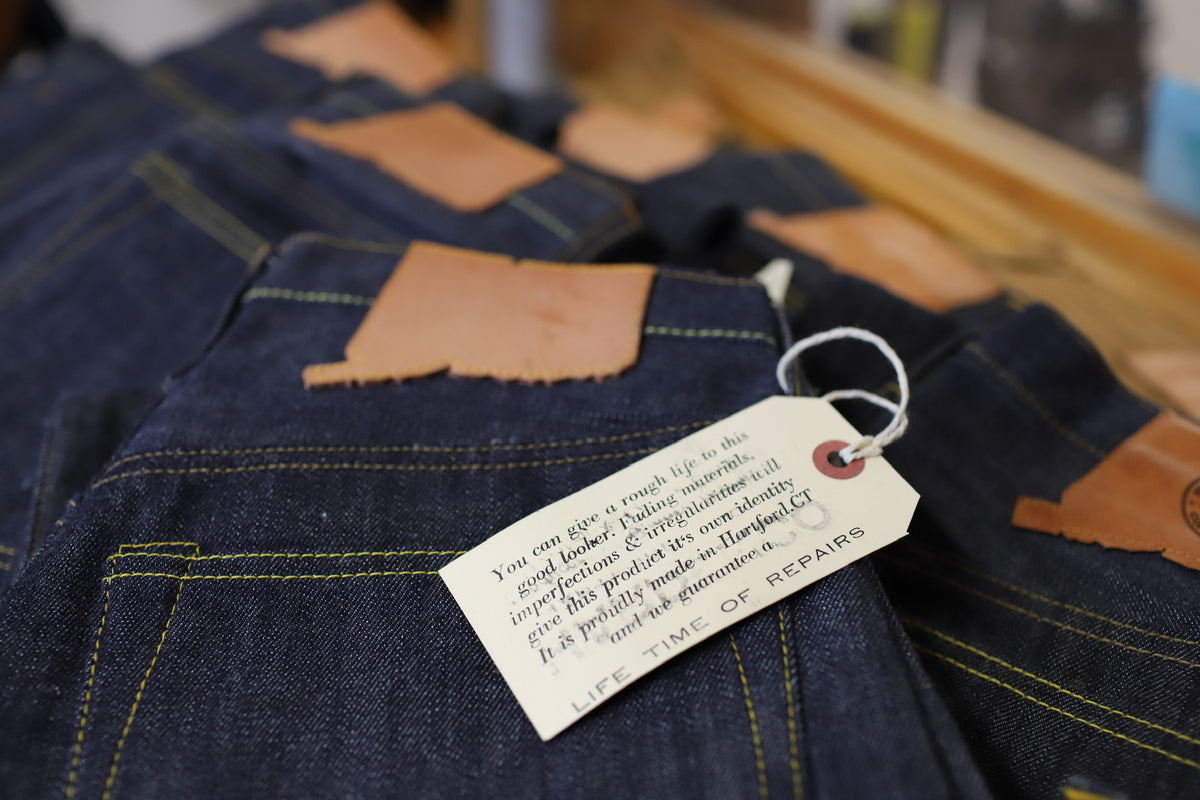
Hartford Denim Company, which signs everything it makes as Hardenco, cuts and sews jeans, work jackets, aprons and bags in a small shop in New Hartford, Connecticut, about twenty miles northwest of the city it is named for. Its two owners make nearly every piece themselves on sewing machines older than they are. Their newest jean is woven in Georgia, their best is woven on the old White Oak looms in Greensboro, and every one of them carries the same promise on a paper tag: whatever happens to it, they will fix it, for free, for as long as it lasts.
A Hundred Pairs in Three Months
Luke Davis, Marshall Deming and Dave Marcoux grew up in West Hartford and met at Conard High School. They were campers, and on their trips they started making their own wallets and belts. They noticed that good camping gear was built to survive, and the jeans they could buy were not. Davis began taking pants apart, vintage Levi’s among them, to see how they were made. There was sewing in the family background: Deming’s mother was a seamstress, and Davis learned from his grandmother. Marcoux learned from the other two.
In two thousand ten, a few years out of college and in their twenties, they gave themselves a test: build one hundred pairs of jeans in three months. They worked in their parents’ basements and garages. The father of a friend, who ran one of the last sewing shops left in Hartford, let them use his cutting room. By the end of that summer they had a workshop and a name, Hardenco, short for Hartford Denim Company. Deming has said they are “100 percent self-taught.” Davis put it more simply to Litchfield Magazine: it began as a hobby, and they just did not stop.
“We see jeans as a tool to protect you from the elements and from hard jobs.” Marshall Deming
Built in Hartford
The jeans were stamped inside “Built in Hartford, Connecticut,” with a leather patch cut in the shape of the state above the back pocket, and that patch is still the brand’s signature. They were raw selvedge, never sanded or stonewashed, built in about fifty steps on antique industrial machines the friends found on Craigslist and restored. Heddels, reviewing an early pair in two thousand thirteen, found a first run in fourteen-ounce Japanese denim from Nihon Menpu with Cone plaid pocket bags, oversized back pockets doubled and riveted, and chainstitching throughout. The plan was to move to Cone denim from North Carolina, and they did. Thread came from New Bedford, Massachusetts, and rivets from Baltimore.
What made people notice was the promise that came with them. Every Hardenco piece is backed by free repairs for the life of the garment. The founders wanted customers to keep their jeans and wear them out, and they wanted to be the ones who fixed them when they broke. NBC Connecticut visited in March two thousand twelve and found jeans at two hundred fifty dollars off the rack and three hundred fifty made to order, several hundred pairs sold, and a shop struggling to keep up. Davis said what went into a pair was worth far more than they charged for it. In two thousand thirteen the MetroHartford Alliance named the company its best new start-up.
Aprons, Bags and a Mechanic’s Shop
The jeans built the name; the rest of the catalog built the business. Hardenco began making heavy shop aprons for cooks, bartenders, welders and woodworkers, and the aprons found a commercial market of their own: by two thousand fifteen, The Take magazine reported, George Dickel Tennessee Whisky was ordering them three hundred at a time for its bartenders. Then came totes, dopp kits, a waist pack, a log carrier modeled on one found at the town dump, canvas and denim work jackets, work shirts, and a backpack Deming says he spent twenty years designing. Japanese and Swedish shops took the jeans: there are stockists in Osaka and Gothenburg, and the shop sewed a special run for Beekman in Osaka in two thousand seventeen.
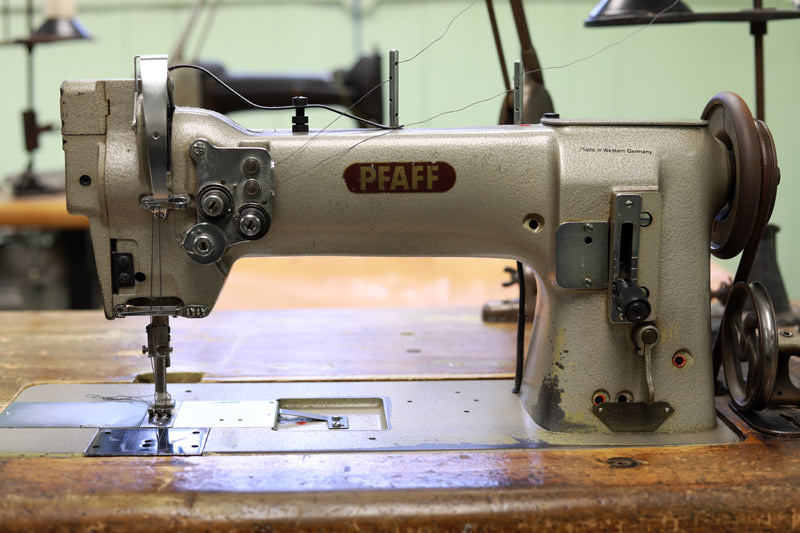
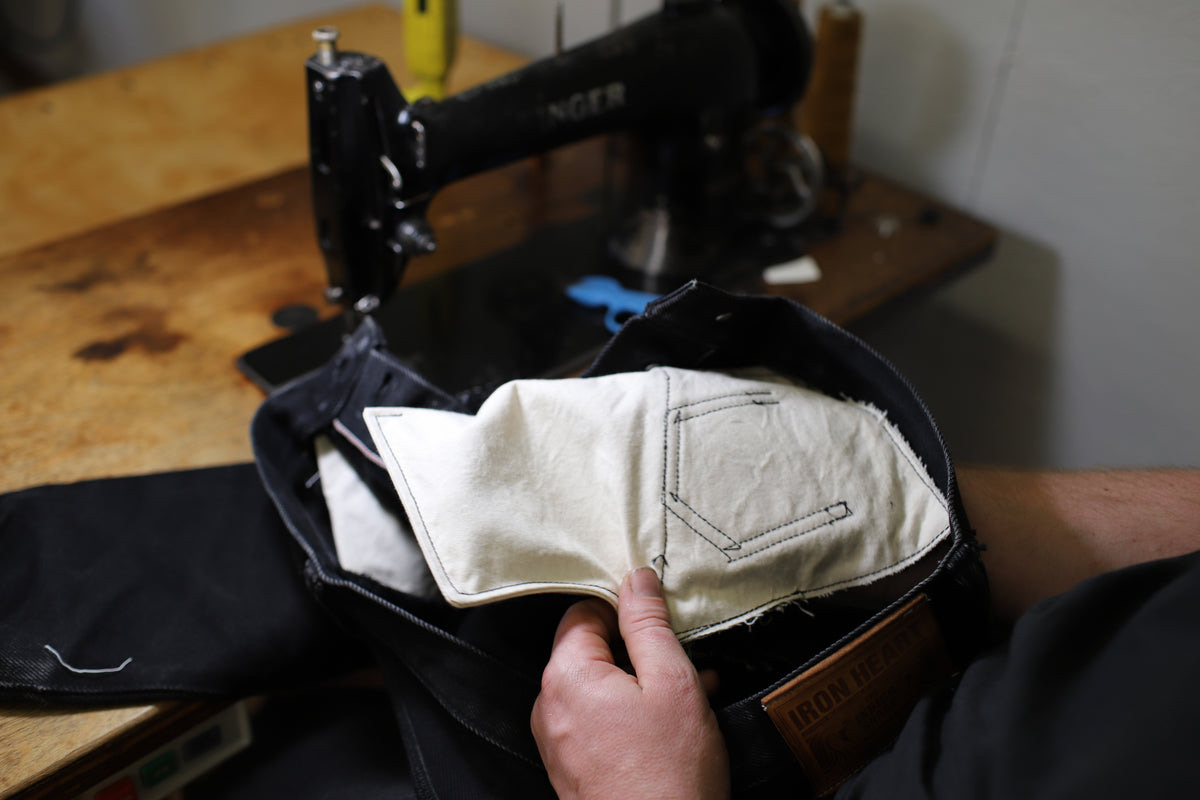
The machines were part of the argument. Davis told Yankee Magazine in two thousand fourteen that old machines are easier to find and easier to run. “With the old machines, you need a mechanic to fix them,” he said; with the new ones, “you need a computer technician.” The shop today runs mostly on vintage Singers, plus two big machines salvaged from a battleship, and it prints its own labels on an antique treadle press. The repair promise grew into a repair business. The workshop now fixes jeans, jackets and bags from any maker, replaces worn-out pocket bags, takes back jeans too thin to save in trade, and runs a kids’ program that swaps a child’s pair for the next size up until the child turns eighteen.
“If we made it, we will fix it, free of charge.” Hardenco
Moving Day, Again
Hardenco has rarely stayed put. After the basements came a rented room, then an industrial building on Arbor Street in Hartford by early two thousand twelve, then the basement of an old brick factory on Bartholomew Avenue in the Parkville neighborhood, where The Take found a staff of five and jeans at two hundred thirty-five dollars in two thousand fifteen. A shop on Hamilton Street followed in two thousand seventeen. Then the company left the city that gave it its name for New Hartford, first a nondescript building off Main Street and now the mill on Greenwoods Road. Each move meant hauling cast-iron machines, and each came with its own lease and its own risk.
The market did not always cooperate either. When Hardenco started, skinny jeans were everywhere and a heavy, roomy, unsanforized jean was a hard sell. The company says some of its original sixteen-ounce Cone White Oak jeans, made as early as two thousand twelve, went unsold for more than a decade, until it found them while moving and put them back on sale. Then, in two thousand seventeen, Cone closed the White Oak plant in Greensboro, the last big selvedge mill in the country and the source of the American cloth Hardenco was built on. By two thousand twenty-three, when Litchfield Magazine visited, the business was down to its two owners, Davis and Deming, doing the design, patterns and sewing themselves.
“What we are selling is the beauty of a well-worn garment.” Luke Davis
Back on the White Oak Floor
The answer to the lost mill came from Greensboro. In two thousand nineteen Cone donated two of its old Draper X-3 shuttle looms, and Evan Morrison, who had co-founded the Greensboro shop Hudson’s Hill in two thousand thirteen to sell clothes made from Cone denim, began restoring them inside the White Oak plant. By May two thousand twenty they were weaving five days a week. In two thousand twenty-one the work became Proximity Manufacturing Company, a subsidiary of the nonprofit White Oak Legacy Foundation, named for the first mill the Cone brothers opened in eighteen ninety-six. As of early two thousand twenty-four, Proximity was weaving about one hundred yards of selvedge a day, mostly from yarn spun and rope-dyed at Mount Vernon Mills in Trion, Georgia.
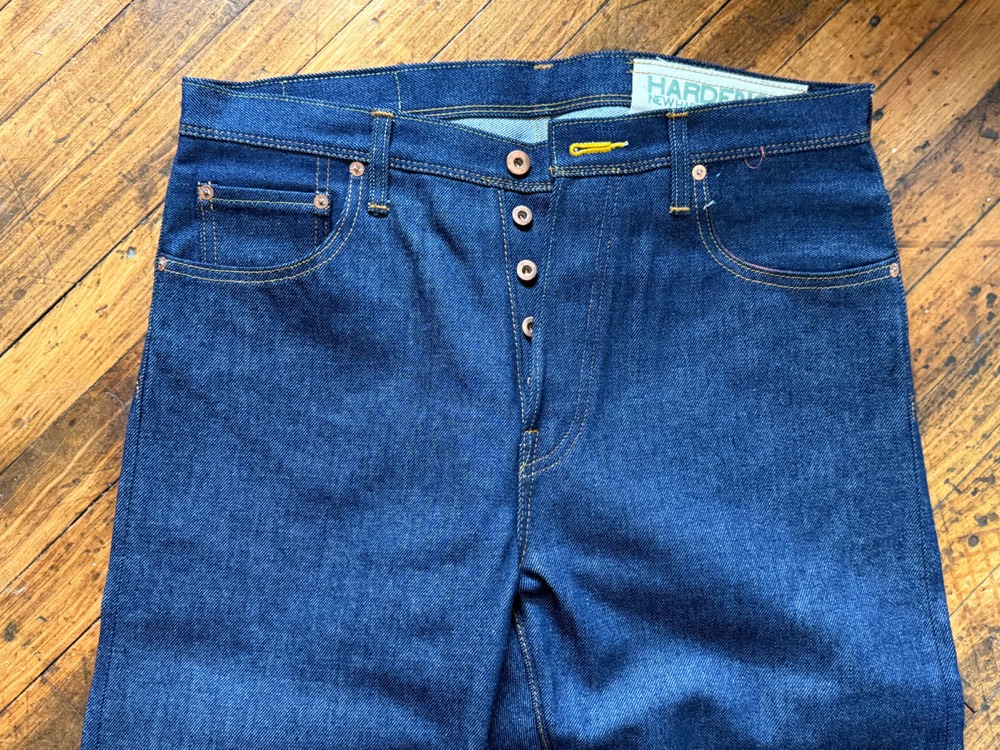
Hudson’s Hill spent a year developing a jean with Hardenco on that cloth, and the first run was sewn in New Hartford at the end of two thousand twenty-two. It is a twelve-ounce unsanforized right hand twill with a dark grey weft, a cloth White Oak made seventy to ninety years ago, cut in Hardenco’s 003 pattern: high rise, full leg, a slight taper. It uses American-made YKK buttons and rivets, Perma-Core thread, and leftover White Oak canvas for the pockets. You shrink it to fit the old way, sitting in a hot bath in it for half an hour. This year Hardenco added an everyday jean beside it. The 001 Basic American Jean is its original fit, cut in thirteen-and-a-half-ounce indigo denim woven by Mount Vernon Mills on modern projectile looms, sewn in larger runs with what the company calls wartime-style technique to bring the price down. It launched with the first two hundred fifty pairs at two hundred fifty dollars, shipping from the Fourth of July, for the nation’s two hundred fiftieth year.
Inside the Greenwoods Mill
Hardenco’s address, 37 Greenwoods Road, is the old Greenwoods Company mill on the east bank of the Farmington River. The first brick mill went up there in eighteen forty-eight and forty-nine, beside a dam that made Greenwoods Pond. It wove heavy cotton: duck for sails and tents, belting, twine and felts, on looms that could make cloth more than eighteen feet wide. In eighteen eighty the mill had two hundred twenty-six looms and five hundred twenty-five workers. Around the turn of the century the company moved south to Alabama, to escape high labor and freight costs and Connecticut’s new limits on workers’ ages and hours. The New Hartford Historical Society estimates that a third of the town left within a year.
For a few years after that, the building belonged to the Mount Vernon-Woodberry Cotton Duck Company, the Baltimore duck combine whose name has come down to Mount Vernon Mills, the Georgia company that now weaves the 001. Then came silk printing, vacuum cleaners and mixers, Underwood typewriters, aircraft parts, springs and Ovation guitars. A cotton mill that left New England for the South more than a century ago is now home to a jeans maker sewing cloth woven in the South, under the same roof.
001 Basic American Jean
The original Hardenco fit, high rise and straight, in thirteen-and-a-half-ounce Mount Vernon Mills indigo. Cut long and hemmed to your inseam (put it in the order notes). Woven in Georgia, sewn in Connecticut, repaired free for life.
003 Unsanforized, Proximity Double Indigo
Twelve-ounce shuttle-loom selvedge from the old White Oak floor in Greensboro, in a forties-style full leg. It shrinks to fit in a hot bath. Made with Hudson’s Hill; repairs honored in New Hartford and Greensboro.
Standard Denim Worker’s Jacket
A plain, sturdy chore-style jacket in fourteen-ounce Cone denim with YKK copper buttons and reinforced seams. The pocket-heavy counterpart to the jeans, and covered by the same repair promise.
Go Further
The Bottom Line
Hardenco is what the revival looks like at its smallest and most stubborn. Two self-taught makers sew American-woven denim on rescued machines inside an eighteen forties cotton mill, and they promise to repair whatever they sell for as long as it lasts. It has never been big, and it has had to move, shrink and lose its mill along the way. It is still sewing, and its two flagship jeans are now American from the loom to the last stitch.