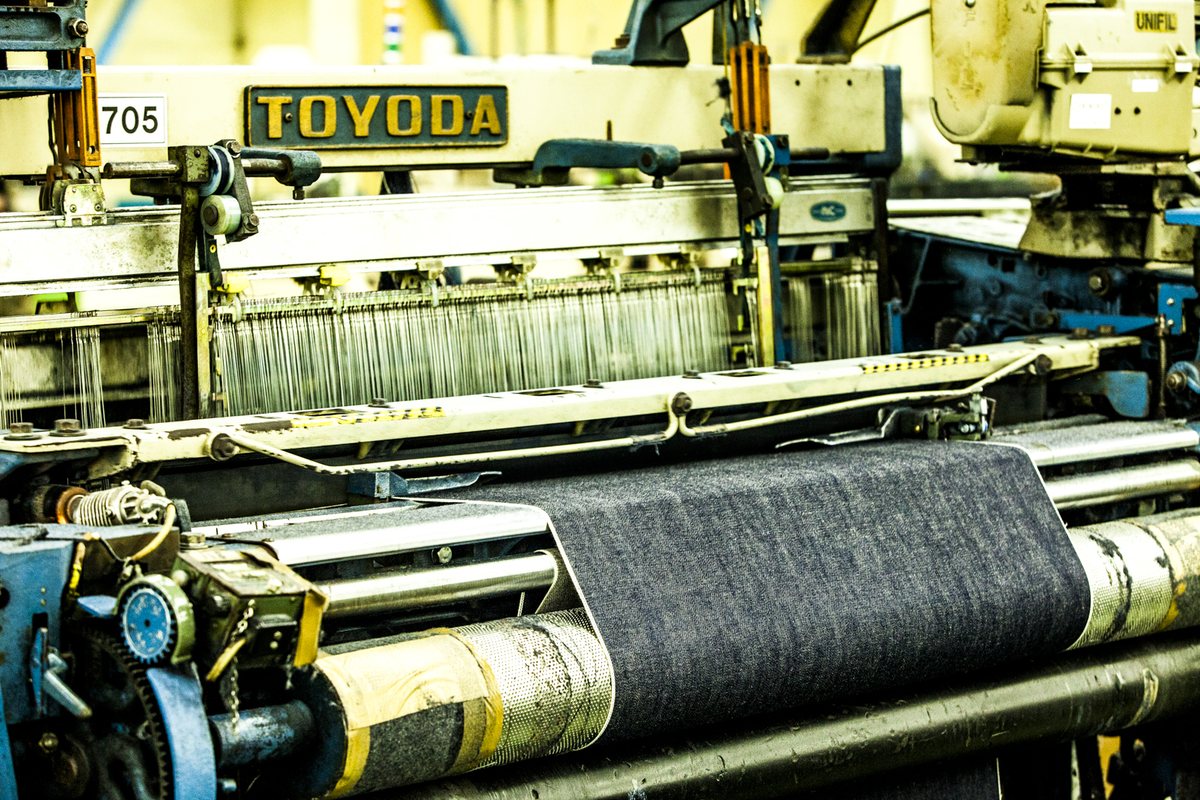
Read the fabric line on enough of the jeans profiled in this publication and one name keeps coming back. Tellason in San Francisco cuts its jeans and jackets from it. Brave Star in Los Angeles sews it. Freenote, Railcar and Shockoe Atelier list it, and so does Hiut in Wales. Since Cone shut its White Oak plant in Greensboro at the end of two thousand seventeen, a large share of the selvedge denim sewn in America has been woven in one Japanese prefecture, much of it by one family company. This is the story of that company, and of how a mill that began by weaving kimono cloth by hand learned to make the American fabric better than most of America still does.
Blue Thread in Bingo
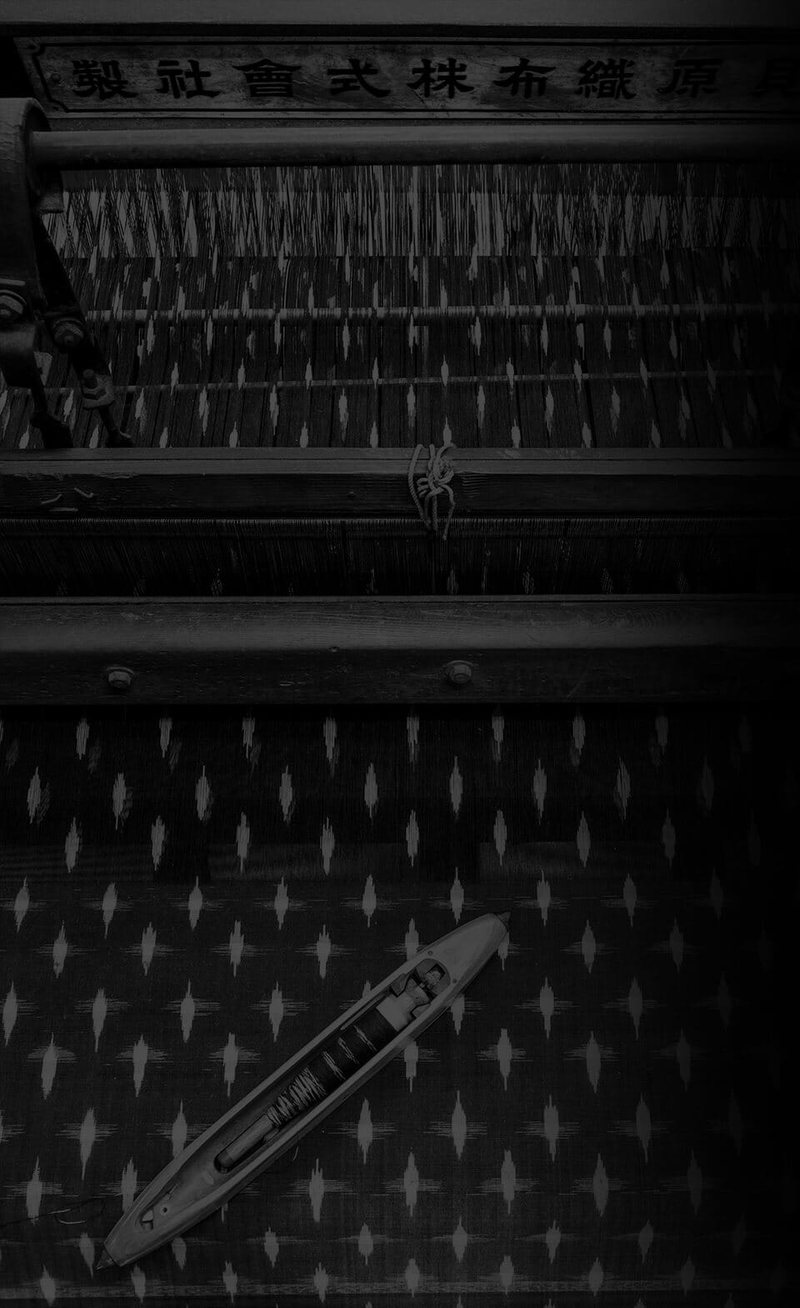
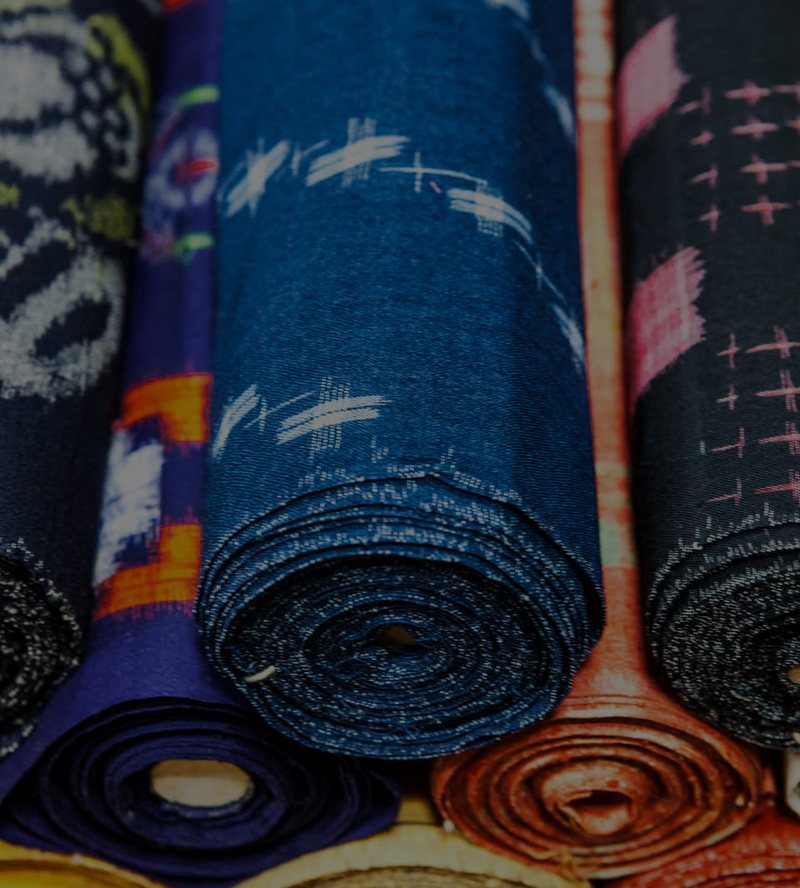
The country around Fukuyama, in eastern Hiroshima Prefecture, was once called Bingo, and for more than a century it was known for Bingo kasuri, a cotton cloth whose threads are dyed in patterns with indigo before they are woven, so that soft-edged white marks appear in the blue. Kasuri was work clothing, and it was everywhere. Yoshiharu Kaihara, who would later run the company, remembered growing up there to the sound of looms coming from every neighboring house and indigo thread hanging out to dry along the streets.
In eighteen ninety-three Sukejiro Kaihara, who had learned the kasuri trade, opened his own weaving business in the village of Tsunekanamaru, now part of Fukuyama, making hand-woven, true-indigo Bingo kasuri under the trademark Marusu. Japan was at war with China and then with Russia, and money was short, but within ten years the business had thirty people turning out five thousand bolts of kasuri a year. In nineteen twenty Sukejiro’s son Satoru took over and set out to grow it.
Thirty-Four Looms
The Second World War nearly finished it. When the Pacific war began in nineteen forty-one, the yarn ration stopped. The family kept going by making woven hats and rope for the military, but after the surrender nobody wanted kasuri. At its height the business had run about three hundred looms. By the time it was incorporated as Kaihara Orifu in nineteen fifty-one, with eighty-three employees, it had thirty-four.
The third-generation head of the family rallied the people who were left with a simple instruction, which the company still prints as its founding idea. Put yourselves in the place of the people who will wear it, he told them, and make something truly good with everything you have. They began building their own machines. In nineteen fifty-four they patented an automatic indigo dyer that dipped and squeezed the yarn under the surface of the dye bath, the way a towel wrung out underwater stays dry inside, which saved dye and labor and was sold to kasuri weavers in other prefectures. In nineteen fifty-six they wove the first power-loom kasuri wide enough, at thirty-six inches, for Western clothes. The big Dai-Nippon Spinning company, now Unitika, bought in. By nineteen sixty-one Kaihara was weaving forty-eight inch kasuri sarongs for export to Aden, in what is now Yemen, where they sold as a luxury.
“Put yourselves in the place of the people who will wear it, and make something truly good with everything you have.”
Seven Months to Make Blue
Then it happened again. In nineteen sixty-seven Britain pulled its forces out of Aden and devalued the pound. The letters of credit stopped. Kaihara was left holding about a year of sarongs nobody would pay for, and in nineteen sixty-nine it stopped making them. Revenue fell to a third of what it had been, and half the staff were gone. “The business was in terrible shape,” Yoshiharu Kaihara told the Chugoku Shimbun, Hiroshima’s paper, in two thousand eighteen. “We were on the edge of bankruptcy.”
Yoshiharu, born in nineteen forty-three, had left a job at a textile trading house to come home when the family business ran into trouble. In the autumn of nineteen sixty-nine, with young people around the world wearing jeans as a badge of the movement against the Vietnam War and Japan’s first homegrown jeans brands just starting out, clothing makers and wholesalers began asking the family whether it could dye yarn for denim. His father was against it. Yoshiharu was sure the dyeing skill the family had built on kasuri could compete with anyone. The problem was money. “No bank would lend to us,” he recalled. Even the savings his father and brother had put by could not secure a loan.
Kasuri thread is dyed all the way through, and denim dyed that way does not fade the way jeans should. The family heard that in America the yarn was gathered into long ropes and dipped again and again so the indigo stayed near the surface, leaving a white core that shows through as the cloth wears. So they built their own rope-dyeing machine, adapting the underwater squeezing method from their kasuri dyer. It took seven months. In nineteen seventy Kaihara put Japan’s first rope-dyed denim on the market. Within a year the orders came to about three hundred thousand pairs of jeans’ worth of cloth, and in nineteen seventy-three an order came from Levi Strauss.
Water, Ninety-Eight
The Levi’s order made the name, and the rest compounded from there. By nineteen seventy-six Kaihara was rope dyeing one hundred thousand bolts a month and held three quarters of the dyeing market in Japan. It opened a mill at Kisa in nineteen seventy-eight, built a spinning plant in nineteen ninety-one and, with that, became the first company in Japan to do every step of denim under its own roof: spinning, dyeing, weaving and finishing. That year the old weaving company changed its name to Kaihara. In nineteen ninety-four, as Japanese collectors began paying serious money for old American jeans, it put its vintage shuttle looms into full production of the narrow selvedge cloth those jeans were made from.
The man who ran the company through those years learned the trade from his elder brother, who had led it before him and who liked to point out that the Japanese character for dyeing, 染, is built from the characters for water and for nine, ten and eight. “Yoshiharu, the character for dye is written water, ninety-eight,” he would say. “Water is what matters.” The company signed a pollution agreement with its town in nineteen seventy-five and built its own wastewater treatment plant the same year.
“The character for dye is written water, ninety-eight. Water is what matters.”
The next big turn came in nineteen ninety-eight, when Uniqlo came calling. Yoshiharu Kaihara remembered hearing that it meant to sell jeans for two thousand nine hundred eighty yen and assuming someone had made a mistake in the math. He came away impressed that its chief, Tadashi Yanai, would not compromise on the cloth. Uniqlo has been a customer ever since. The mix of cheap and precious is the company’s whole character. In two thousand nineteen TV Tokyo reported that Kaihara wove about twenty-four million meters of denim a year, enough for some twenty-one million pairs, sold to more than three hundred brands, and developed about eight hundred new fabrics a year, keeping five thousand old samples in a room the staff call the garbage room. The same mills supply Levi’s, A.P.C., Edwin and Uniqlo, and the small American workshops that turned to Japan when White Oak closed.
How It Is Made
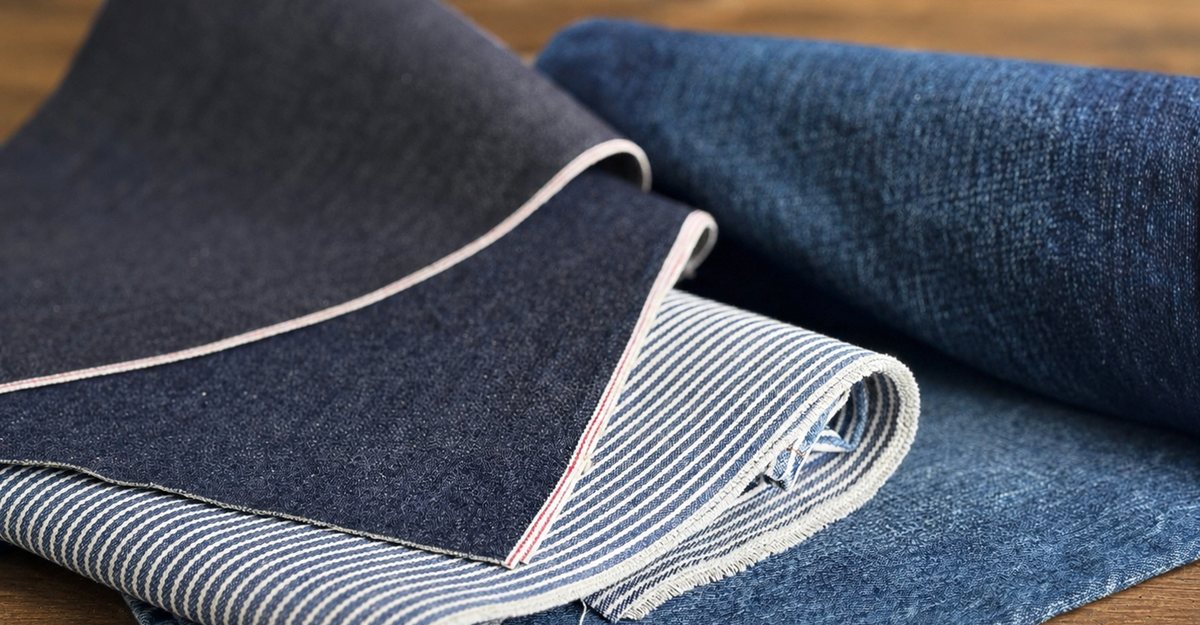
The cotton is the one part that does not start in Japan, and some of it starts in America. Kaihara buys from the big growing regions, naming the United States, Australia and Brazil, and keeps four to five months of cotton on hand. Everything after the bale happens in the company’s own mills in Hiroshima Prefecture: the main mill in Fukuyama, and mills at Kisa, Joge and Sanwa. It spins both ring and open-end yarn, ties six hundred to nine hundred threads into ropes about six thousand yards long for the indigo, weaves on about two hundred old shuttle looms at Joge alongside modern projectile and rapier looms, and singes, sizes and shrinks the finished cloth. Since two thousand fifteen it has also run a plant in Ratchaburi, Thailand, which dyes, weaves and finishes; Kaihara says that cloth is made to the same standard as the Japanese. The farms behind the cotton are not published, and Kaihara does not say which customers get Thai cloth and which get Japanese.
The Population Problem
The family that weathered a war and the loss of a market has spent this century facing a slower threat. Japan’s textile districts have been shrinking for fifty years. Yoshiharu Kaihara traced it back to nineteen sixty-nine, when Tokyo agreed to limit textile exports to the United States in talks that led to the return of Okinawa, and the trade complained that Japan had bought Okinawa with thread. Kaihara was too busy turning from kasuri to denim to join the protests, but it watched the region’s weavers close one by one.
For decades the company held that it would make denim only in Japan. In two thousand fourteen it changed its mind and set up in Thailand, its first factory outside the country, which Yoshiharu called as big a decision as the move from kasuri to denim. The reason was not cost but people. “There is empty land next to our factories in Hiroshima,” he said. “But every area where we have a factory is losing population.” As orders grew, there were not enough workers to hire. Today Kaihara employs about five hundred eighty-seven people in Japan and some three hundred fifty in Thailand. In two thousand twenty-four it folded its two spinning plants into one.
“There is empty land next to our factories in Hiroshima. But every area where we have a factory is losing population.”
The family has also had to hand the company on. Yoshiharu Kaihara stepped down as chairman in March two thousand twenty-two. In two thousand twenty-five the family formed a new holding company, Kaihara Blue Holdings, which took full ownership of Kaihara the next year. On June first, two thousand twenty-six, Yoshiyuki Kaihara, forty-one, became president of both. He is the son of the fifth-generation president, studied at Waseda’s graduate school of science and engineering and worked for a carmaker before joining in two thousand seventeen. The year before, the company had shown for the first time at Première Vision in Paris and Kingpin in Amsterdam, the trade fairs where the world’s brands buy cloth. Its president’s message ends on a line from the dye house: never forget that everything begins with the quality of a single thread.
Uniqlo Slim Straight Selvedge Jeans
Co-developed with Kaihara and woven with thicker warp yarns at a looser density for a fuller, older look. The cheapest way to own Kaihara selvedge, sewn overseas, and the clearest demonstration of what the mill does at scale.
Brave Star True Straight, 11oz Kaihara Selvage
A light, slubby Kaihara selvedge with a deep indigo face, cut and sewn in Los Angeles in Brave Star’s classic straight leg. Raw character without a punishing break-in.
Tellason Coverall Jacket, 14.75oz Selvedge
Tellason’s chore coat in heavy Kaihara selvedge, sewn in San Francisco by the company that switched to Kaihara when White Oak closed. A collector favorite.
Go Further
The Bottom Line
Kaihara is the teacher behind a lot of American denim. A kasuri family that lost its market built Japan’s first rope dyer from a rumor of how America did it, then outlasted most of the American mills it learned from. It spins, dyes, weaves and finishes in its own mills in Hiroshima, some of it from American cotton, and now in Thailand too. When an American maker says its jeans are sewn here from Japanese selvedge, this is very often the mill it means.