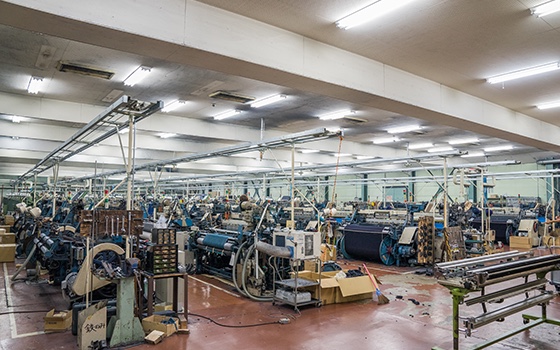
Last week this publication profiled Kaihara, the Hiroshima mill behind much of the selvedge sewn into American jeans since Cone’s White Oak plant closed. Read the fabric lines a little longer and a second Japanese name turns up just as often. 3sixteen in New York has had its house denim custom woven by it for more than fifteen years. Freenote Cloth in California builds its westerns on it. Shockoe Atelier in Richmond cuts it. Hiut in Wales sews its flagship jean from it. The name is Kuroki, a family company more than seventy-five years old in Ibara, a town of some thirty-five thousand people in the hills of western Okayama. Today, October twelfth, the local railway’s Denim Train goes back into service with all forty-two of its seats re-covered in Kuroki cloth. In Ibara that is not a gimmick. Denim there is the local industry, and people wear it to meetings.
Blue Before Blue Jeans
The country around Ibara was once called Bitchu, and in the Edo period its rulers encouraged farmers to grow cotton and indigo so the region would have an industry. Yarn spun from that cotton was dyed in the indigo and woven into cloth for ordinary people’s kimono. When Japan industrialized in the Meiji years, hand looms gave way to power looms, and Ibara became known for Bitchu kokura, a heavy cloth for school uniforms and work clothes. One kind, called urajiro, was dyed on its face and left white on the back, and was woven in the same three-by-one twill as American denim. Japan’s tourism agency notes that at least one Ibara company was selling cloth labeled “blue denim” by nineteen thirty.
After the war, used American jeans began turning up at the Ameyoko market in Tokyo, and from there they spread across the country. Sewing houses opened in Ibara and in Kojima to make jeans of their own. At first, Tatsushi Kuroki recalls, they sewed imported American cloth, including denim from Cone Mills. As the craze grew, so did demand for denim made at home, and the weavers of Bitchu already knew the basic technique. By about nineteen seventy, roughly three quarters of the jeans made in Japan were made in Ibara. Kuroki puts the peak at eighty percent.
Not Kimono Cloth
Tamotsu Kuroki founded the weaving company Kuroki Shokufu in nineteen fifty in Nishiebara, on the edge of Ibara. In its first decade it wove cotton for clothing and for industry: gingham, heavy plaids and plain white cloth. In the nineteen sixties it began making denim from yarn dyed in hanks, skeins dipped in the dye one batch at a time. The market, as the company’s own history puts it, then moved to rope-dyed denim, and in the nineteen seventies Kuroki gave itself over entirely to cloth for jeans.
His son Tatsushi grew up in Saichigo, a corner of Nishiebara, went to school in Ibara and studied electronic and industrial engineering at Osaka Electro-Communication University. He had no plan to weave. His professor, who also ran a maker of measuring instruments, pressed him to join that company, and he considered it. What decided him was the cloth his father was making. “If Kuroki was still producing cotton cloth for kimono clothing, I might have taken the offer,” he told Mood of Living in two thousand nineteen. “However, the fact that the company was producing denim made me reconsider. Denim has been, and will be worn world-wide, and the thought excited me.” He joined in nineteen seventy-five, when, as he put it, every youngster wore jeans, and was first assigned to the apparel side rather than the mill. The year before, the family had split its sales arm off as a separate company, Kuroki Co., Ltd., which is the Kuroki of today. He is now its president.
“If Kuroki was still producing cotton cloth for kimono clothing, I might have taken the offer. However, the fact that the company was producing denim made me reconsider.”
Bringing the Work Home
For its first four decades Kuroki was a weaver and nothing more. “Initially at Kuroki we used to purchase the yarn, dye at an outsourced dyeing facility, weave internally and outsource the finishing,” Tatsushi Kuroki explained. Every step that left the building was a step the company could not control: the shade of the indigo, the hand of the finished cloth, the date it would ship. So it began pulling the steps inside. In nineteen eighty-eight it built a product center with its own finishing line, to singe, wash, straighten and shrink the cloth that came off its looms. In nineteen ninety-six it built a dye center and put in its own rope-dyeing range, along with warping and sizing machines. With that, every step from dyed yarn to finished roll happened in Ibara, in three plants a short drive apart.
The dye house is where Kuroki’s story turns on water. Ibara has soft water, and Kuroki credits it for its color, which the company describes with an old Chinese phrase for the blue of the sky in the moment the clouds part after rain. When the dye center opened, Tatsushi Kuroki says, water quality was the thing he worried about most. The plant cleans its wastewater with equipment he says purifies four times better than the standard machine, and the water flows to vegetable fields and the rice paddies of Okayama’s Asahi rice before it reaches the river and, eventually, the Seto Inland Sea. Solar panels on the factory roofs make more than a tenth of the company’s power.
Five Hundred Cloths
Until the turn of the century Kuroki sold almost entirely in Japan. Then the premium-jeans boom of the early two thousands pulled it into the United States, and from the middle of that decade it took a booth at Première Vision in Paris, the fair where the world’s fashion houses buy cloth. Getting into foreign markets, Tatsushi Kuroki told WWD Japan last year, went surprisingly smoothly. Overseas buyers now account for about sixty percent of sales.
The reason they could buy so easily is the most distinctive thing about the company. “The denim market swings hard, and the gap between good years and bad years is huge,” he said. “We kept developing this and that to narrow the gap, and before we knew it we were making five hundred fabrics a year.” Kuroki keeps most of those five hundred in stock and will sell them in small lots, which is exactly what a small foreign brand needs. The range runs from heavy slubby selvedge for collectors to denim woven with cashmere, and wide cloth off big modern looms at a lower price. When Heddels visited its booth in two thousand fourteen, its most popular cloth, and the president’s own favorite, was a plain thirteen-ounce red-line selvedge that he called the perfect weight for all four seasons.
3sixteen is the clearest example of how that model reaches American jeans. In the late two thousands its founders, Andrew Chen and Johan Lam, wanted a denim no one else had, which usually means an order far bigger than a small brand can afford. Kiya Babzani of the San Francisco shop Self Edge introduced them to Kuroki. “They were immediately open and receptive to working with us,” the founders told Rope Dye. Kuroki took a smaller order than it normally would, and the result was 3sixteen’s 100x, woven from long-staple Zimbabwe cotton rope dyed seven times. “It was a scary step for us to take,” they said. “It was more denim than our company had ever committed to buying before.” The same cloth is still woven for them today.
“It was a scary step for us to take. It was more denim than our company had ever committed to buying before.”
Bigger names followed. Kuroki will not say which designers use its cloth, but Tatsushi Kuroki has said it works with most of the major European houses, and a two thousand sixteen television profile named Ermenegildo Zegna among its customers. In April two thousand twenty-three, LVMH Métiers d’Art, the arm of the luxury group that partners with and invests in the craftsmen its brands depend on, named Kuroki its first partner in Japan. The Kuroki logo is now registered as a trademark from China and Korea to the United States and Canada.
How It Is Made
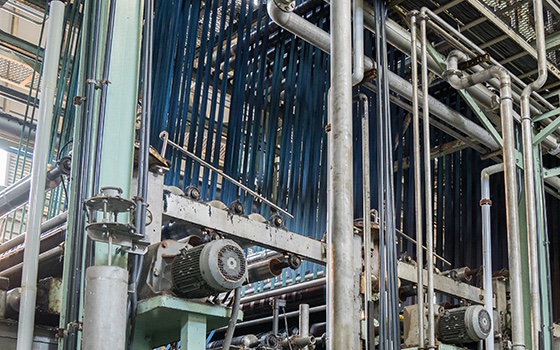
Kuroki does not grow or spin. It chooses cotton from around the world with Japanese spinning companies, which make the yarn to its specification; the only growing region it has named for a particular cloth is Zimbabwe, for 3sixteen’s 100x. Everything after the yarn happens in Ibara. In the dye center, five hundred warp threads are gathered into each rope and eight ropes run through the range at once, dipping into the indigo anywhere from four to ten times and coming out green before they oxidize to blue. Naruhiko Ii of Kuroki told the Toronto tailor Philip Sparks last year that North American buyers tend to want four dips, for a brighter blue, while Japanese and European buyers usually want seven. The yarn is then split back into single threads, starched and woven, either on the vintage Toyoda shuttle looms that make its selvedge or on modern Sulzer projectile and rapier looms. The finishing plant singes the cloth, washes it, sets the skew so the legs of the jeans will not twist, and sanforizes it to control shrinkage before every roll is inspected by eye over a light box.
Break It If You Must
Kuroki’s hard years have been the slow kind. When Tatsushi Kuroki joined in nineteen seventy-five, Japan’s textile industry already seemed to be losing its momentum while cars and electronics boomed, and a young engineer had better offers. Denim itself has never been steady, which is why the company built a range of five hundred cloths: to keep the looms running when one kind of jean falls out of fashion. And the home market is shrinking. A June report from JETRO, Japan’s trade agency, noted that domestic demand for textiles keeps narrowing and that many family-run mills in the region are reluctant to sell abroad. Kuroki went abroad two decades ago and stayed home. Asked in two thousand twenty whether cheaper foreign producers worried him, Tatsushi Kuroki said no: “We do not want to produce our fabrics in any other country.”
The deepest risk sits on the weaving floor. The old shuttle looms that give selvedge its character are no longer made. Money cannot buy a new one. When ONI Denim, a small and famously exacting Japanese brand, asked Kuroki for a cloth with a surface rougher than any loom was built to weave, getting there meant experiments that could wreck the machine, and nobody on the floor wanted to be the one who broke an irreplaceable loom. Ryotaro Nakayama, who founded the Japanese crowdfunding company Makuake, described in Forbes Japan in two thousand twenty-one what the company told its people: try it, even if it breaks. If a loom is ruined, they would sweat their way around Japan until they found someone with the same model to spare. The cloth worked.
Tatsushi Kuroki’s rules for running the company are plain: take a profit and put it away, keep costs low, and remember that in a small town, jobs are everything. His view of the hard years is in the rope.
“Life is like an intertwined rope. When you make a hemp rope, one would go up and the other one would go down. There are good times and bad times. Tomorrow is another day.”
3sixteen CS-222x Classic Straight
A twelve-ounce black-on-black selvedge woven by Kuroki for 3sixteen alone, rinsed so it is soft from day one, and made in the USA. It fades to grey rather than blue. The brand’s flagship 100x indigo, also Kuroki, runs about $270 when sizes are in.
Hiut Benjamin, OG Japanese Selvedge
A fourteen-and-a-half ounce red-line selvedge from Kuroki in a tapered fit, made start to finish by one machinist in Cardigan, Wales, and signed inside the pocket.
Freenote Cloth Modern Western, 11oz Bleached
A western shirt in eleven-ounce Kuroki selvedge, given a ten-year bleached wash, with horn buttons and turquoise snaps. Sewn in Los Angeles.
Go Further
The Bottom Line
Kuroki is the other teacher behind a lot of American selvedge. A gingham weaver in a town that once made most of Japan’s jeans bet on denim, then brought the dyeing and finishing it used to send out under its own roof. It dyes, weaves and finishes in three plants in Ibara, from yarn spun for it in Japan, and keeps five hundred cloths in stock so a small brand can order like a big one. When an American maker says its jeans are cut from custom Japanese selvedge, this is often the mill it means.