
At the turn of the twentieth century, Landon Clayton King was raising champion bird dogs in the foothills of the Appalachians. He had spent twenty-five years selling for his brother’s wholesale dry-goods business in Bristol, the twin city straddling the Tennessee and Virginia line, and he had an idea the dry-goods trade was not built to serve: a man tracking quail through brush, or working a long day on a farm, needed clothes tough enough to survive it. In January 1913 he left and started his own company across the street. He named the first line after the animals he knew best, the pointers in his kennel, and he stamped it with the dog he loved most. The Pointer in the Pointer Brand logo is not a Madison Avenue invention. He is Carolina Bill, King’s favorite birddog, remembered as “very intense” with “excellent style and character” on point. More than a hundred years later, the company is still in the same building, still in the same family, and still making the same coat.
The Bird-Dog Man
King built the original wing of the factory by hand and went to work, and he did not stop. He died in 1954, eighty-three years old, still coming in to the factory he had founded forty-one years earlier. The standard he set was the one he had used on his dogs: breed for the work, judge by performance, accept nothing soft. The slogan that grew out of the kennel, for champion performance, was not a tagline so much as a description of the only thing the company knew how to sell. The clothes were not fashionable. They were correct. A pair of triple-stitched overalls or a four-pocket chore coat was a tool, and like a good tool it was expected to outlast the person who bought it.
The Pointer in the logo is not a Madison Avenue invention. He is Carolina Bill, King’s favorite birddog, “very intense” with “excellent style and character” on point.
Workwear for a Working Country
The spark was the work itself. Bristol sat in the middle of farm and mill and coal country, and L.C. King made what that country wore to the job: bib overalls, dungarees, chore coats, all of it cut to take abuse and sewn to be repaired rather than replaced. The construction was the product. Triple-needle felled seams, bar tacks at every stress point, rivet-reinforced pockets, a heavy shank button. None of it was decoration; all of it was there because a seam that failed in the field was a seam the company would hear about. In those first decades the appetite for honest American denim was so large that L.C. King was, by the company’s account, Cone Mills’ biggest customer in the early years, before a San Francisco outfit named Levi Strauss took that title. The clothes worked, the orders came, and a small Tennessee factory turned into an institution.
From a Region to a Retail Empire, and Back
For most of the century the compounding was steady and regional: more overalls, more coats, the same garments in denim, brown duck, hickory stripe, and wabash, sold across the South and up into the workwear heartland. Then it scaled. Under the founder’s grandsons, who ran the company from the 1970s, L.C. King became a major contract supplier of hunting and outdoor apparel for Bass Pro Shops and other large retailers. The little factory in Bristol was suddenly feeding a national chain, sewing under other people’s labels at a volume the overall business had never touched. For a while it looked like the future of the company. It was, instead, the setup for its hardest decade.
The little factory in Bristol was suddenly feeding a national chain. It looked like the future. It was the setup for its hardest decade.
The Decade That Almost Ended It
The trade agreements of the 1990s did to L.C. King what they did to nearly all of American apparel. As production rushed offshore under deals like NAFTA, the big retailers chasing the lowest price went with it, and the contract work that had become the company’s backbone evaporated. The factory that had survived the Great Depression, two floods, and a fire was suddenly a domestic sewing operation in a country that had decided it no longer wanted one.
The man who walked into that was Jack King, the founder’s great-grandson. He had not grown up on the factory floor; he had spent a dozen years as a tax accountant in Atlanta when his father called, in poor health, and asked him to come home and help. He started as an employee in 1998, just as the bottom fell out of the wholesale business. “We needed to find a new customer base,” he has said, and the way he found one defined the company that exists today. Instead of chasing the retailers who had left, he went around them, straight to the people who actually wore the clothes. The company asked customers to mail in photographs of themselves in their L.C. King overalls and coats, built relationships one letter at a time, and rebuilt itself as a direct made-in-USA brand rather than a supplier. Alongside it, King turned the factory’s deepest asset, a century of cut-and-sew craft, into a second line of business: private-label and collaboration work for designers and brands around the world who wanted something genuinely sewn in America. The factory that the big retailers had abandoned became the factory that fashion houses sought out.
It worked. The doors stayed open, in the same downtown Bristol building King had built, and the company came out the other side as something rarer than it went in: a survivor. “We are solely focused on giving the customer a 100 percent made-in-the-USA jean, overall, jacket or coat,” Jack King says. “That’s what we stand by.” The case he makes for it is not patriotic so much as practical. “There’s a need to be made in America,” he says, “if you want something to last.”
Thirty Pairs of Hands and a Cutting Machine From 1918
L.C. King is not a label that designs in one place and makes in another. It is a factory. Garments are drafted, cut, and sewn on site in Bristol by around thirty pairs of skilled hands, the owner’s among them, kept running by two mechanics and a floor of machinery much of which was installed in the 1950s. One cutting machine has been in service since 1918. Finished jeans are hemmed on a Union Special chainstitch machine and then washed in the company’s own laundry, low and slow, for softness. The cloth is American: the indigo denim comes from Mount Vernon Mills in Trion, Georgia, the country’s oldest surviving denim mill, weaving since 1847, and the same mill this publication has profiled. It is, fittingly, an inheritance of the Cone relationship that built the company a century ago. The one link the company does not publish is the farm the cotton is grown on, so we mark that step as reported rather than confirmed.

The proof of the method arrives by mail. Under a lifetime repair guarantee, customers send garments back to be mended, and the ones that come in are often twenty years old. “When you see the repairs that come in, a lot of people have had these overalls or jeans for twenty years,” King says. “That shows the craftsmanship.” The plant manager, Marinda Lee Holt, frames the same idea from inside the building. “Being fourth-generation, made in USA still means a lot,” she says. “We try to keep the heritage of our workwear.”
The Oldest Family Apparel Maker in America
The lineage here is not a revival borrowed from a defunct mill; it is an unbroken line. L.C. King calls itself the oldest family-owned apparel manufacturer in the country, and the claim is hard to argue with: founded in 1913, run by the King family across four generations, still operating from the building the founder put up. The heritage is not in a museum case. It is the 1918 cutting machine still cutting, the 1950s sewing heads still sewing, the pewter shank button still stamped 1913, the same four-pocket chore coat the company has made since before the First World War. Where the rest of this series tells the story of Americans rebuilding what the country lost, L.C. King tells the story of the rarer thing: the company that simply refused to leave, and kept the lights on in Bristol while almost everyone else went dark. The barn coat the company sells today is described, plainly, as the one your grandfather wore, because for a great many families it literally is.
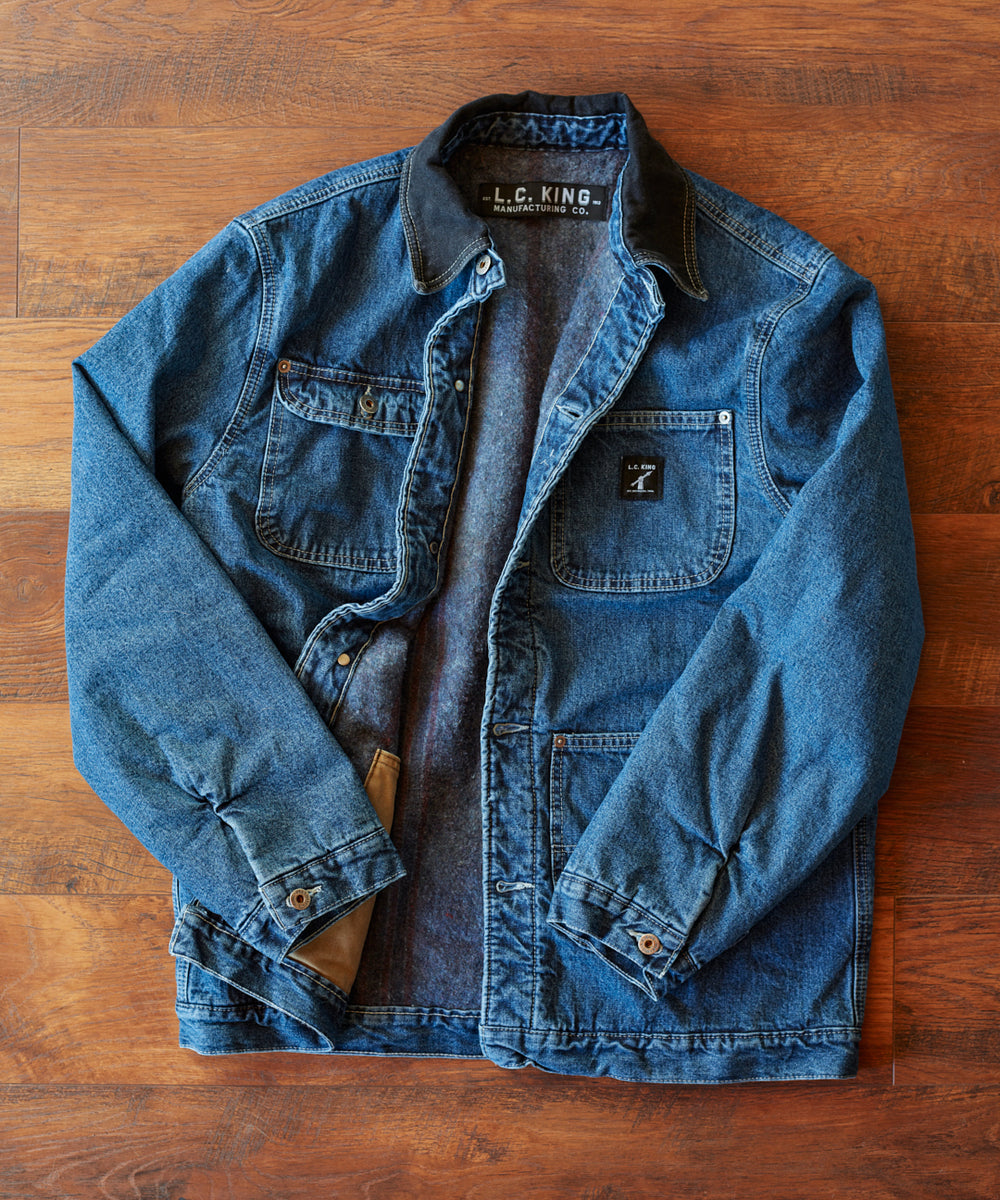
Rigid Denim Core Chore Coat
The four-pocket coat the company has made since 1913, cut from eleven-and-a-half-ounce rigid indigo denim woven at Mount Vernon Mills, with heavy bar-tacking and a felled-seam build. Unwashed and ready to shrink and fade to its wearer. For the buyer who wants the single most L.C. King thing in the catalog.
Indigo Denim High Back Overalls
The garment that defined the company: a high-back bib overall in washed indigo denim with triple-needle felled seams, a zippered bib, hammer loop, and rust-proof hardware. True to fit, not vanity sized. For the buyer who wants real American workwear at a working price.
Denim Barn Coat
A twelve-ounce Mount Vernon indigo denim coat, blanket-lined with quilted sleeves and a contrast collar, washed low and slow in house. Rebuilt from the ground up for movement but still the coat your grandfather wore. For the buyer who wants one warm coat for the next twenty winters.
Go Further
The Bottom Line
L.C. King is the control group for this whole series. Where the heritage-denim revival is a story of Americans rebuilding what was lost, L.C. King is the proof that it did not all have to be lost in the first place. A bird-dog man started it in 1913, his great-grandson saved it in the 1990s by selling straight to the people who wear the clothes, and the same factory in the same Tennessee town still cuts the same chore coat from American denim. The machines are old, the family is on the floor, and the coats outlast the people who buy them. That is not nostalgia. It is what continuity looks like when nobody quits.