Look at the supply chain map on any profile in this publication and you will find the same quiet gap. Cotton grown in Texas or Alabama. Denim woven in Trion, Georgia, or Kojima, Japan. Cut and sewn in Los Angeles or Brooklyn or Bristol, Tennessee. Between the field and the loom there is a step nobody puts on the hangtag, because no brand has ever sold a jean on it: somebody has to turn a bale of raw cotton into yarn. In the United States, more often than not, that somebody is Parkdale.
Parkdale Mills is the largest manufacturer of spun yarns in the world and the largest consumer of cotton in the United States. It is privately held, headquartered on a street called Cotton Blossom Circle in Gastonia, North Carolina, and almost nobody outside the trade has heard of it. It has no consumer brand, no flagship store, no collaboration drops. It sells cones of yarn to people who make cloth. It is the least visible link in the American chain and, by weight, the largest.
The Boy on the Bicycle
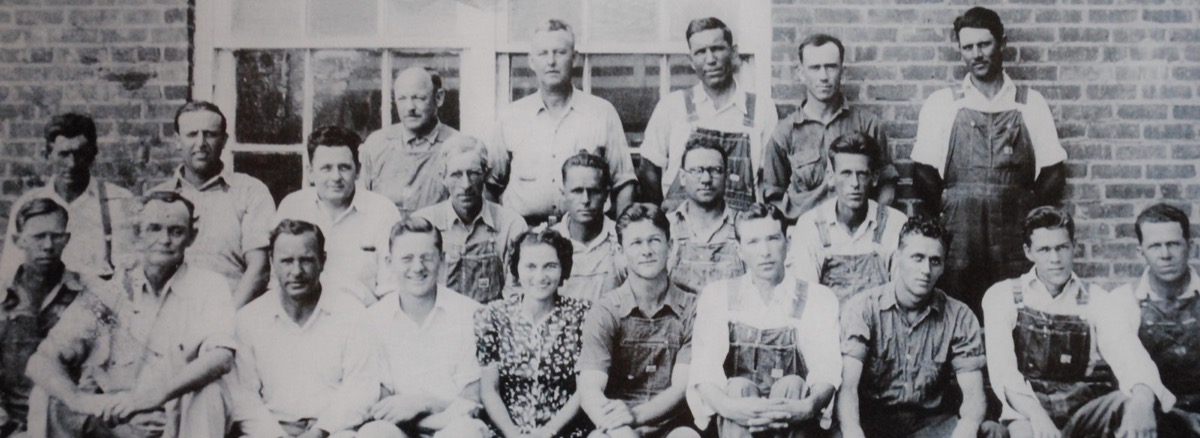
He was born six miles from the mill and named after the power company. His father worked for Duke Power for years, so the family called the son Duke, and his mother, a public school teacher, pushed him toward school and toward independence. At fourteen he started riding his bicycle over to Parkdale Mills asking whether there was any work. The mill’s owner, Bill Robinson, took an interest, started handing him jobs, and told him before he left for the war that there would be a place for him when he got back.
Kimbrell served in the Second World War and took a lesson out of it that he repeated for the rest of his life.
Fighting in the war taught me that I would have to work hard for whatever I wanted in life.
Parkdale helped pay for his education when he came home. He enrolled at North Carolina State’s School of Textiles alongside a cohort of returning GIs and took his degree in nineteen forty-nine. He had better offers elsewhere. He went back to the mill anyway, and he was straightforward about why: he saw a faster path to the top there than anywhere else, and, he said, he loved the place. Robinson stayed his mentor until he died, and Kimbrell kept visiting him to the end.
Chartered in Nineteen Sixteen
Parkdale was chartered in nineteen sixteen in Gastonia by J. Lee Robinson and J.H. Separk, and began operating in nineteen eighteen. The company’s own history is candid about how small it started: one plant, four hundred and twenty-five tons of thread yarn a year. It did well through the twenties and then hit the Depression like everyone else. In nineteen thirty-one a fight broke out inside the company over a proposed merger into a combine called Textiles, Inc. The conflict ended with the founder’s death by suicide. His family kept control, and Fred L. Smyre, Sr. took over as manager.
Fifty years after the charter, a second Gastonia plant doubled the company’s output. That is the entire first half century: two plants and a going concern, in a county that had dozens of them. Gaston County was one of the densest concentrations of cotton mills anywhere in the country, and being one more spinner in Gastonia was not a distinction.

The Compounding
After Robinson died, the board gave Kimbrell an unusual mandate: go acquire and revamp the mills, with the backing of a silent partner. He worked at that for decades. In nineteen eighty-two he finally got ownership, a fifty-fifty split with the George Henry family, and with control came the run that made the company. In nineteen eighty-six alone Parkdale bought Perfection Spinning, Linford Mills, Rowen Cotton Mills, and Acme Spinning. Output went to three and a half million pounds a week and sales past three hundred million dollars, and Parkdale became the largest yarn spinner in the United States.
By nineteen ninety-one it was running eighteen plants with more than twenty-nine hundred employees, turning out two hundred and fifty million pounds of yarn a year on more than four hundred million dollars in sales. Kimbrell had inherited a company of roughly a hundred and fifty people and eleven million dollars in sales. By the end of his tenure it was thirty-six hundred people and nine hundred and thirty-four million.
Textile World eventually ranked him the second most influential textile executive of the twentieth century. He took the Samuel Slater Award for lifetime contributions to the industry, chaired committees at the American Textile Manufacturers Institute, served as a vice president of the National Cotton Council, and put three million dollars into an endowed scholarship fund at the school that had trained him. He died at his home in Gastonia on the twenty-second of October, two thousand fourteen, at eighty-nine, having spent more than seventy years at the same company he had biked to as a boy.
The Son-in-Law
Andy Warlick left Milliken in nineteen eighty-four to come work for his father-in-law. Four years later, at thirty-two, Kimbrell made him president and chief operating officer. Kimbrell was sixty-five. Warlick has since said the gap in their ages was the point, that it forced a culture willing to try things, and he has run the company as chairman and chief executive ever since. His son Davis now runs Parkdale International in Mexico and Colombia. It is a third generation of the same arrangement, which is how privately held textile companies in the Carolinas tend to survive: nobody has to explain a ten-year capital decision to a quarterly earnings call.
Warlick’s bet has been automation, and he does not hedge about it.
We are committed to robotics in a way that no other U.S. company is.
The company funds research, buys prototypes, and keeps what it describes as an open door to any new form of automation. Part of that is competitive and part of it is demographic. Spinning plants are hot, loud, capital-heavy places in small towns, and even celebrated American manufacturers struggle to hire the technicians who keep them running. Parkdale has also gone the other direction from most of the industry on diversification, buying U.S. Cotton in two thousand eight, a maker of swabs, cotton balls, rounds and pads for nearly every major retail chain in North America. It gave the company a way to use its position in cotton without competing against its own customers.
What Spinning Actually Is
The most detailed public account of how Parkdale works came not from Parkdale but from a small North Carolina T-shirt company, Solid State Clothing, which buys its yarn from the company’s Spunlab specialty division and published a long interview with Andy Long, Spunlab’s vice president of sales and marketing. It is worth walking through, because it explains why the step is hard and why it disappeared from most of the country.
It starts with grading. The Department of Agriculture classes every ginned bale, pulling a sample and measuring staple length, diameter, color, and trash content. Parkdale takes that data and engineers what the trade calls a laydown, a group of about seventy bales chosen to blend into each other. One field that went short of rain gives thinner fiber than a field that got a good season, and the laydown is the arithmetic that averages those differences out before they can show up in the cloth. A machine then shaves an inch or two off the top of each bale in the line, continuously, so the blend stays even.
The cotton is cleaned with air, screens, and beater bars to knock the vegetable matter loose, then blown through overhead ducts to the cards.
Carding is really the workhorse of a cotton mill.
Cotton off the field is tangled and irregular. Carding starts to comb the fibers parallel and pulls out trash and short fiber, and what comes off is a web that gathers into sliver, a soft rope of fiber that drops into a can. Then comes drawing, which is where uniformity is actually won: eight cans of sliver combined into one, then six of those combined again, sometimes a third pass, each doubling averaging out the irregularities a little further. Ring-spun yarn can also be combed, the most expensive step in the process, which strips out roughly a quarter of the total volume as short fiber and leaves a longer staple, a higher sheen, and a better yarn. Then roving, which mostly just makes the strand smaller, from about the thickness of a broomstick down to about a pencil, and adds enough twist to hold it together on the way to the spinning frame.
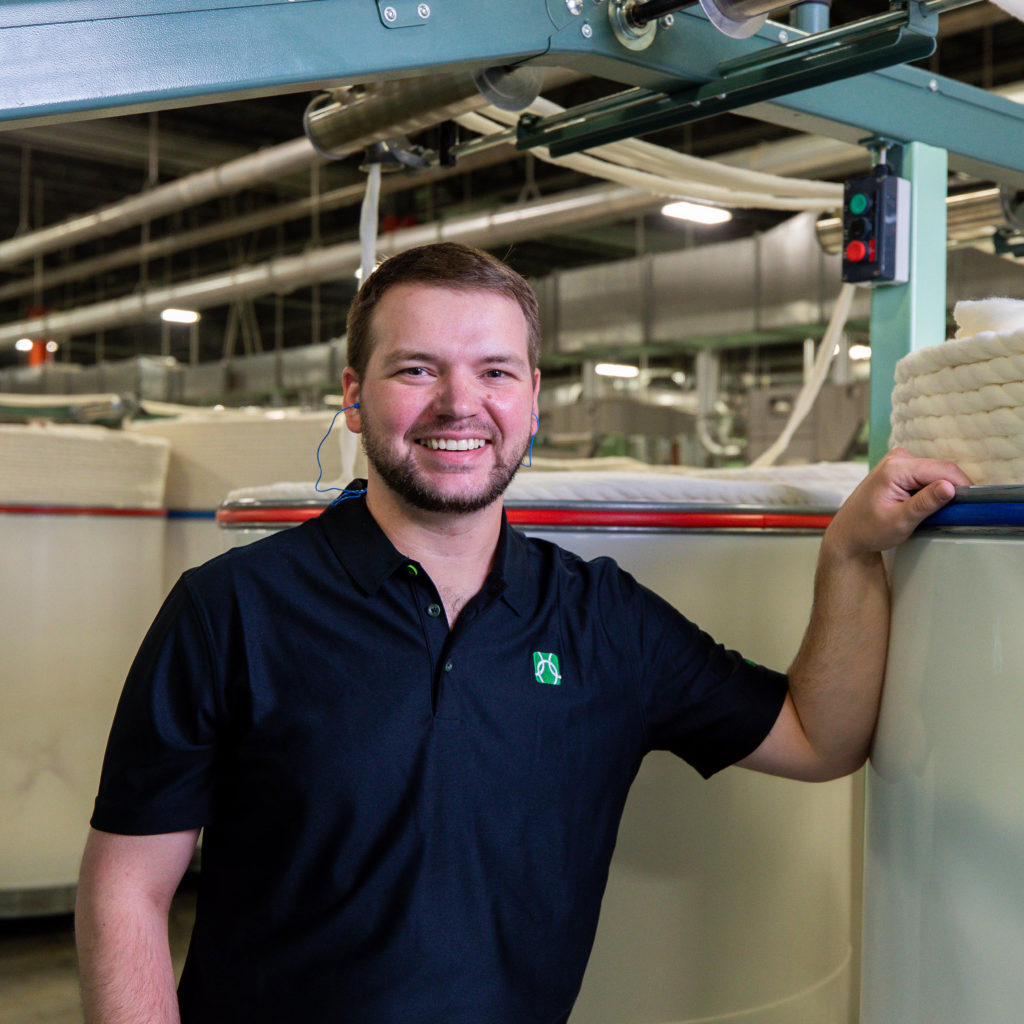
That is the knowledge base a country loses when its spinning goes offshore, and it is why the denim revival kept running into the same wall. A brand can buy sewing machines and teach itself to sew. It cannot easily reconstitute a plant that blends seventy bales to a computed average.
Where the Denim Comes In
Parkdale lists what its yarn becomes, and denim is on the list. The company’s ring-spun page names denim and twills first among weaving end uses, ahead of bedding, military fabric, towels, and workwear. Open-end spinning, the faster and coarser process, feeds the bulk categories. The distinction matters to anyone who cares about denim: ring-spun yarn is the irregular, slubby, more expensive kind that gives vintage-style denim its character, and open-end is the smooth, uniform, cheaper yarn that replaced it across most of the industry in the nineteen seventies.
What Parkdale does not do is publish a customer list, so no profile in this publication can point at a specific pair of jeans and say the yarn in it was spun in Gastonia. Large denim mills frequently spin their own yarn in house; Mount Vernon bought a spinning operation in Rockingham, North Carolina, in two thousand twenty-two for exactly that reason. The accurate statement is narrower and still large: Parkdale is the dominant domestic spinner, it spins yarn for denim among many other fabrics, and it buys more American cotton than any other company in the country.
The Numbers, From the Witness Table
The clearest public accounting of Parkdale’s scale is Warlick’s sworn testimony to a House Homeland Security subcommittee. Parkdale produces nine hundred million pounds of yarn a year, which he translated for the members into a number they could hold: enough to make one and a half billion T-shirts. It consumes seven hundred and fifty-five million pounds of American-grown cotton annually, which he put at roughly sixty percent of all United States cotton consumption. At the time it ran thirty-four operations across the United States, Latin America and Europe, twenty-four of them in this country, spread over eight states.
Then the complication. Ninety-nine percent of Parkdale’s yarn is exported to Western Hemisphere countries, and seventy-eight percent of those exports go to the Northern Triangle, to Guatemala, Honduras and El Salvador, where it is knitted and cut and sewn into clothing that comes back to American stores. The spinning stayed. The steps after it did not, and Parkdale’s business is built on the regional trade arrangement that resulted. Warlick’s estimate is that every single yarn job supports twenty more up and down that chain.
The testimony also contains the pandemic chapter, and it is the same story as Origin’s and Shockoe’s, at industrial scale. Parkdale and its Central American customers retooled production lines, in Warlick’s words literally overnight, and the company became one of the largest domestic suppliers of protective equipment in the country: more than four hundred and fifty million testing swabs, more than a hundred million face masks, more than sixty million isolation gowns.
What Is Happening Right Now
In September of two thousand twenty-four Parkdale told the North Carolina Department of Commerce it was closing its Sanford plant in Lee County, ending seventy-four jobs. The company’s vice president of global human resources, Karen Menting, gave the reason in the filing: the closure was due to significant economic challenges, particularly the rapid increase in energy costs, which had rendered the business model unsustainable. In two thousand twenty-five a plant in Hillsville, Virginia closed. In January of two thousand twenty-six the company announced it would shut its Stokes County mill in Walnut Cove in March, seventy-two jobs. In April it announced Lexington, in Davidson County, would go dark on the seventh of June, sixty-eight more. Both North Carolina filings cited the same cause, a declining economic environment created by rapidly rising energy costs.
Set the counts side by side. In the autumn of two thousand twenty-four the company was described as having roughly forty-five hundred employees worldwide and twenty-nine plants. By April of two thousand twenty-six the figures were about four thousand employees and about twenty plants, ten of them in North Carolina. Parkdale’s own about page still says twenty-nine. Revenue is still around a billion dollars. This is not a company in trouble so much as a company contracting its domestic footprint one small town at a time, and the towns are the ones that had a Parkdale plant and not much else.
For scale, North Carolina had two hundred and ninety-three thousand six hundred textile jobs in nineteen seventy-three. It has roughly thirty-two thousand now.
Warlick in Washington
The other half of the job, for the past decade, has been arguing policy. Warlick has testified repeatedly on behalf of an industry that produced nearly sixty-six billion dollars of output in two thousand twenty-two and invested twenty-one billion in the preceding ten years. His most persistent target is the de minimis rule, the provision that let low-value parcels enter the country duty-free, which he told a Ways and Means trade roundtable in December of two thousand twenty-three had become a loophole for duty-free access to the American market. He closed by saying he looked forward to working with the committee to close it once and for all.
It is worth being plain about what that means and does not mean. The man asking Washington to defend American textile manufacturing runs a company whose yarn is ninety-nine percent exported, and who is closing American plants over the price of electricity. Both of those things are true at once. The de minimis fight is about the finished garments coming in at the far end of the chain, and the plant closures are about the cost of running a spinning frame in North Carolina in twenty twenty-six. A trade rule can be fixed by Congress. The energy bill cannot.
Solid State Clothing NC Cotton Tee
A North Carolina company that buys ring-spun yarn from Parkdale’s Spunlab division and published the whole process to prove it. As close as a shopper can currently get to a garment with the spinning step on the record.
U.S. Cotton
Parkdale’s own consumer division, bought in two thousand eight. The swabs, rounds and cotton balls under Swisspers and a long list of store brands. Not denim, but it is the one Parkdale product sold at retail under its own roof.
An American-chain jean
No jeans brand publishes its spinner. The closest available is a jean on American cotton woven at an American mill, which is what Origin builds in North Carolina on Mount Vernon cloth.
Go Further
The Bottom Line
Spinning is the step the American denim revival cannot rebuild from a garage, and the country is fortunate to still have it at scale. But the largest spinner in the world is exporting ninety-nine percent of what it makes and closing North Carolina plants over the electric bill, which tells you the chain was never really repaired, only shortened at both ends. A jean made entirely in America needs a spinner as badly as it needs a loom. Right now it has one, and the one is getting smaller.