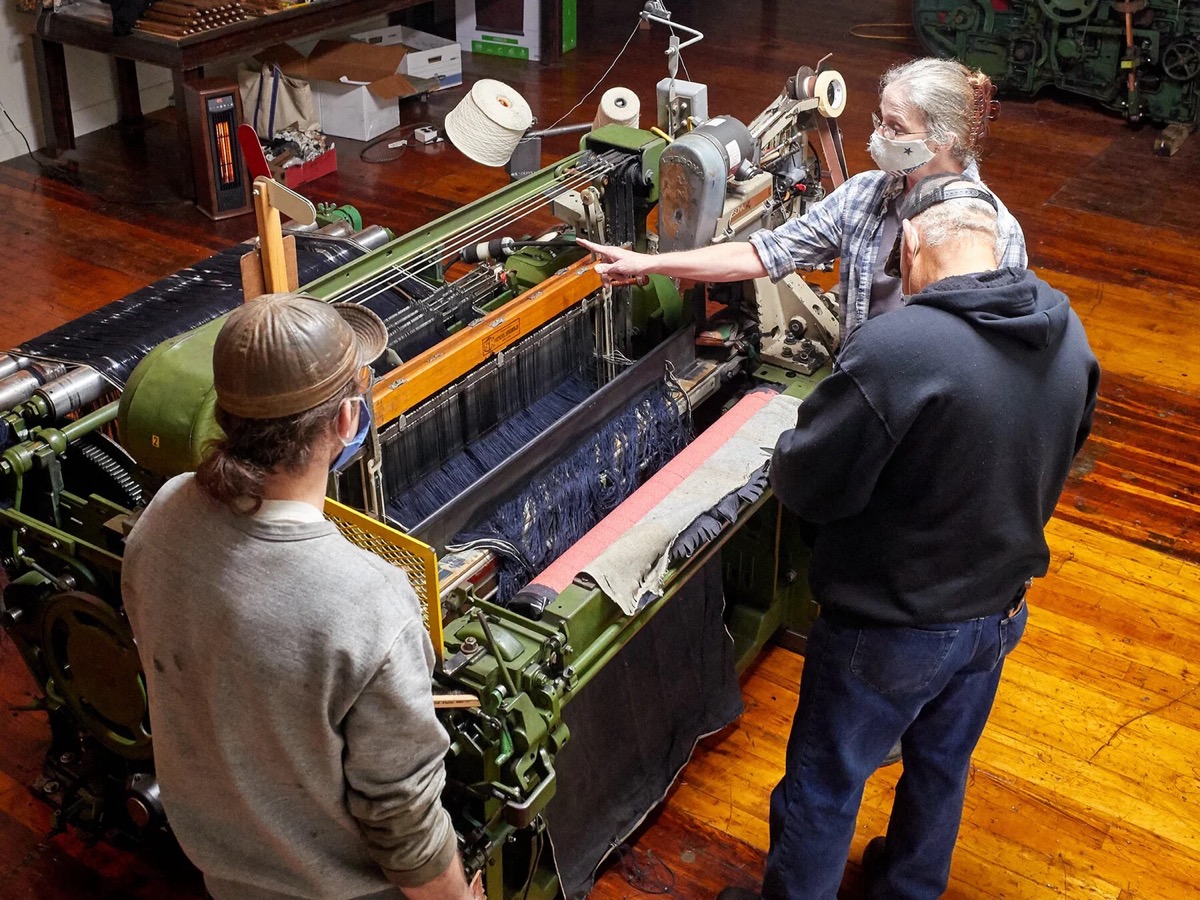
Proximity Manufacturing Company is a micro-mill inside the old Cone Mills White Oak plant in Greensboro, North Carolina. It weaves raw, unsanforized selvedge denim on two Draper X3 shuttle looms that ran in the building for decades, on the original wooden floors, from indigo warp dyed at Mount Vernon Mills in Trion, Georgia. It is the for-profit arm of a nonprofit, the White Oak Legacy Foundation, and it sells its cloth by the roll to a short list of small American brands, who cut and sew it into jeans, jackets, hats, shoes and bags. It is the only denim still woven at White Oak, where the most famous American denim was made for one hundred and twelve years.
A Promise to Stay
Evan Morrison grew up in Greensboro inside the denim business without ever working for it. His day care was a converted mill house painted in Cone’s navy and gold. His mother worked at Moses Cone Hospital, and an aunt was a pattern maker at Blue Bell, the Greensboro overall company that gave the world Wrangler. He left for graduate school in Paris and came home to look after his grandmother, and on her deathbed, he told O.Henry magazine, she asked him to stay and make Greensboro a better place.
After she died in two thousand thirteen, he went looking for what that meant. “I knew I wanted to work in denim,” he said. “That’s what our city’s known for.” White Oak was running full tilt with months of lead time, and nobody in Greensboro was making clothes from cloth woven in Greensboro. That same year Morrison and a father and son, William and Tinker Clayton, opened Hudson’s Hill on South Elm Street, a general store of American-made goods, next door to where Hudson Overall, later Blue Bell, got its start in nineteen oh four. The plan was to sell other people’s American clothes and make their own from Cone denim they could drive across town and pick up. In two thousand fifteen Morrison revived the name of the Cone brothers’ first mill, Proximity, and registered it as a trademark. He coined a nickname for his hometown, Jeansboro, and statues of blue jeans went up around the city.
Two Looms, Left Behind
In October two thousand seventeen Cone announced that White Oak would close. It was weaving about a million yards a year on forty-six looms, and by the end of December they were silent. “It was like, ‘Oh my God, what are we gonna do?’” Morrison remembers. Hudson’s Hill’s business model had just disappeared. Most of the building went to Walmart as a distribution center, and most of the looms were sold off; Vidalia Mills in Louisiana bought them in two thousand nineteen. Two were left.
Morrison cold-called the new owner of the property and talked his way into a lease on a small part of the mill. With a group of business people from across the state, he formed the White Oak Legacy Foundation, W.O.L.F., and asked Cone for the last two looms. Cone gave them through a deed of gift to the nonprofit. Retired Cone hands filled in the rest: his across-the-street neighbor, Bud Strickland, who had worked in product development at White Oak, helped plan the business and opened the door to Mount Vernon Mills.
“Essentially, they gifted them to the city. So the people of Greensboro now own our history.” Evan Morrison
Restoration started in December two thousand nineteen. By March two thousand twenty, Morrison said, they were ready to fire them up. “We wove our first couple of inches and then, of course, all the plastic parts that had dry rotted broke.” It took another month to find replacements. By May the looms were weaving five days a week, slowly, at about one hundred seventy picks a minute, turning out cloth roughly thirty-four inches wide. Morrison, who has an MBA, does the mechanical work himself. “I do all the machine fixing and all of the rebuilding myself,” he said.
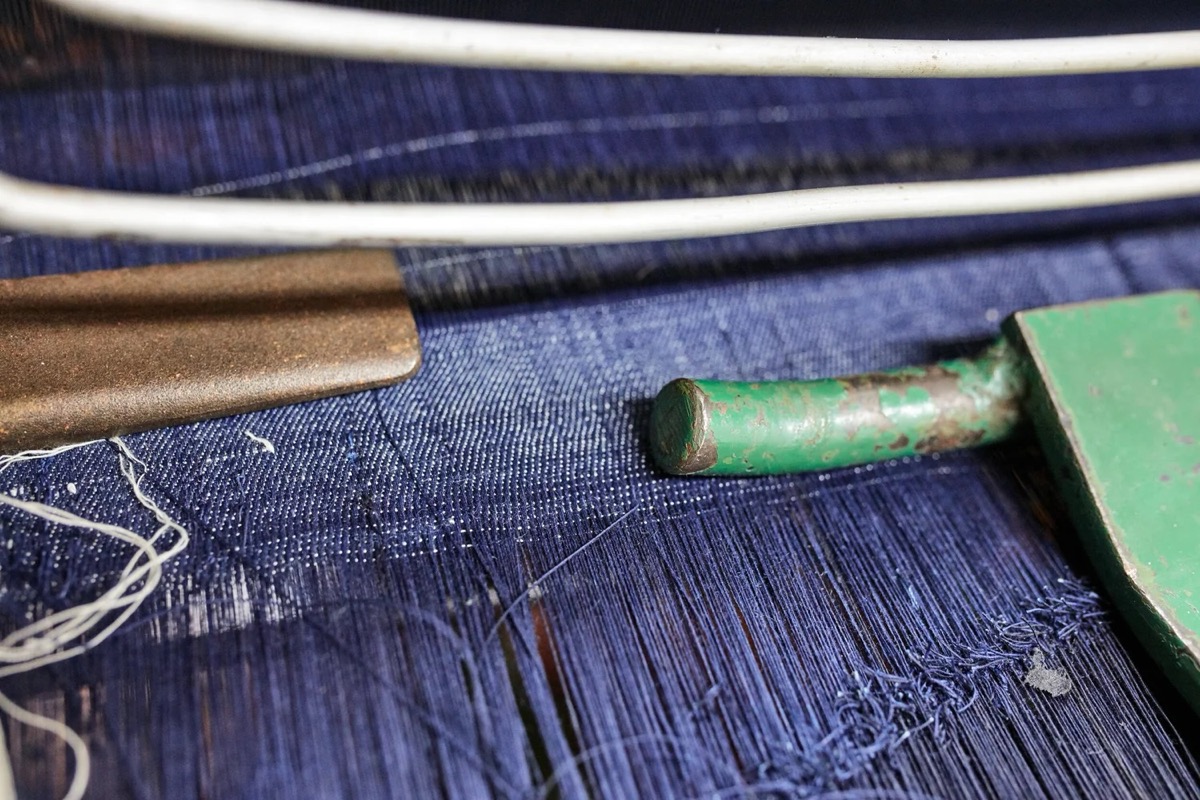
The weaver they called back was Debbie Lindsey, who had worked at White Oak for more than thirty years, as her mother had before her. “This place raised me,” she told Spectrum News in September two thousand twenty-one. “This place raised my son.” When the call came that two looms were starting up, she said, she sat on the couch and cried.
The first cloth was deliberately old-fashioned: a three-by-one right-hand twill of a little over twelve ounces, from American-grown ring-spun cotton dyed in a shade Mount Vernon calls Canyon Blue, left unsanforized and loomstate, meaning nothing is done to it after it comes off the loom except inspection. Each edge carries twelve natural selvedge ends, the same count White Oak used when it began weaving in April nineteen oh five. Proximity likens it to department store western denim of the nineteen fifties. Because it is not preshrunk, it is meant to be bought big and shrunk to fit, the way jeans were sold before nineteen thirty.
Pallets for Two
Morrison wanted the first customers to be the small brands that had built their names on White Oak cloth. Through the photographer Matt Sharkey he reached Tony Patella and Pete Searson of Tellason in San Francisco, who had been one of White Oak’s biggest shuttle denim customers. They were in on the first call. Samples went through hot washes and bathtub soaks on both coasts to learn how the loomstate cloth would shrink, about two to three and a half inches in the waist, and the jean was adjusted to match: a second layer of denim instead of a pocket liner, longer rise and inseam, wartime-style laurel buttons. In December two thousand twenty-one Tellason released one hundred sixteen numbered pairs, one for each year White Oak had stood. The Runabout Goods Brander jacket, a Type I by the designer Mike Hodis, came from the same run, with twenty percent of sales going to W.O.L.F. Raleigh Denim Workshop, which had also been built on White Oak, made its Jones jean in the cloth.
The list grew from there: First Standard NYC, Opie Way sneakers, an STS collection, and a running partnership with Hardenco of Connecticut and Hudson’s Hill on an unsanforized 003 jean that the store says it will always make in Proximity denim. The cloth has broadened to left-hand, right-hand and broken twills and herringbones from twelve to about twelve and three-quarter ounces. Proximity wove what it calls the first bio-based indigo denim on a selvedge loom in the United States, and in two thousand twenty-two the first denim woven with American-grown degummed hemp. Morrison trademarked a trick he calls Weft Out, flipping the cloth so a colored filling yarn shows on the face, which lets a mill this small offer custom color without ordering twenty thousand yards of dyed warp. He told O.Henry that some of that cloth goes to fashion houses selling jeans at three thousand dollars a pair.
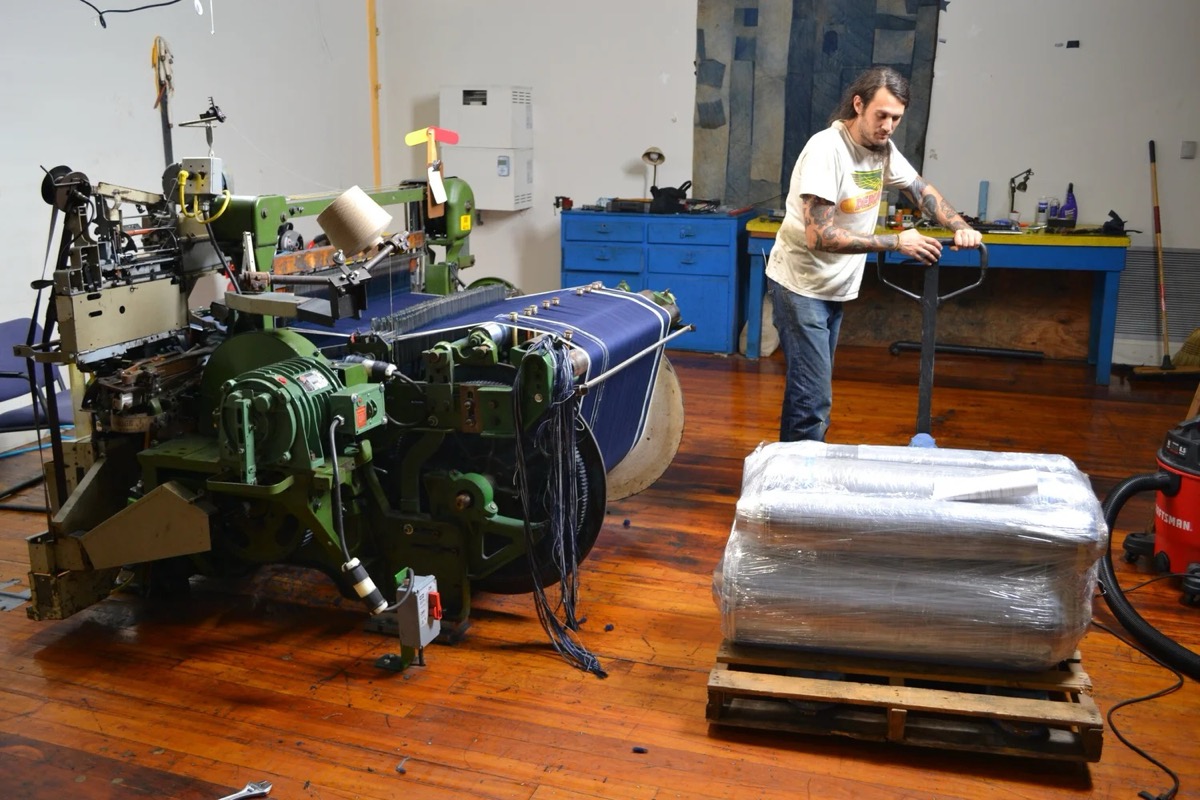
“We’ve shipped pallets of denim, which is kind of surreal because there’s only two of us,” Morrison told Sourcing Journal in August two thousand twenty-five. By then Proximity had woven thousands of yards. It charges about thirty dollars a yard.
The looms also feed the foundation’s classroom. In two thousand twenty-one W.O.L.F. revived Denim 101, a two-day course from bale to finished cloth, with Bud Strickland and his wife, Jill Amidon Strickland, who had run Cone’s own Denim School at White Oak decades earlier. Students tour Hill Spinning in Thomasville, the dye and weave rooms in Greensboro and, since two thousand twenty-five, Origin’s sewing and wash plant in Asheboro. More than two hundred people have taken it, Morrison says, from Gap, Levi’s, Lee, Wrangler and Cone itself, some of them senior people at major denim brands who had never set foot in a denim mill.
The Niche With No Competition
Proximity exists because a much bigger business collapsed, and it lives with that arithmetic every day. A custom indigo shade means ordering about twenty thousand yards of yarn; Proximity can handle about four thousand. Its capacity, in early two thousand twenty-four, was about one hundred yards a day. Every warp beam is a long round trip by truck to Trion and back. Some brands, Morrison said, balk at the price; the ones that stay value the history and the fair wages Proximity pays. He is blunt about the larger picture. Unless there is a third world war, he told Carved in Blue, the manufacturing of the twentieth century is gone for good, and what survives in America will be specialization: “a niche where we have no competition.”
The ambitions have run ahead of the floor space. In two thousand twenty-one the foundation’s chairman, Bob Stec, described plans for a permanent museum, bigger classrooms and a denim innovation center at White Oak, including talks with the Spanish finishing company Jeanologia about a research lab. In February two thousand twenty-four Morrison said Proximity was expanding and hoped to raise capacity significantly within a year. When Sourcing Journal visited in two thousand twenty-five, it was still two looms in what had been the plant’s archive room, and two people. Morrison is the weaver, the loom fixer, the payroll department, the shipping department and quality control. “It might be insane to wear all the hats,” he said, “but it is extremely valuable for our city’s sake.”
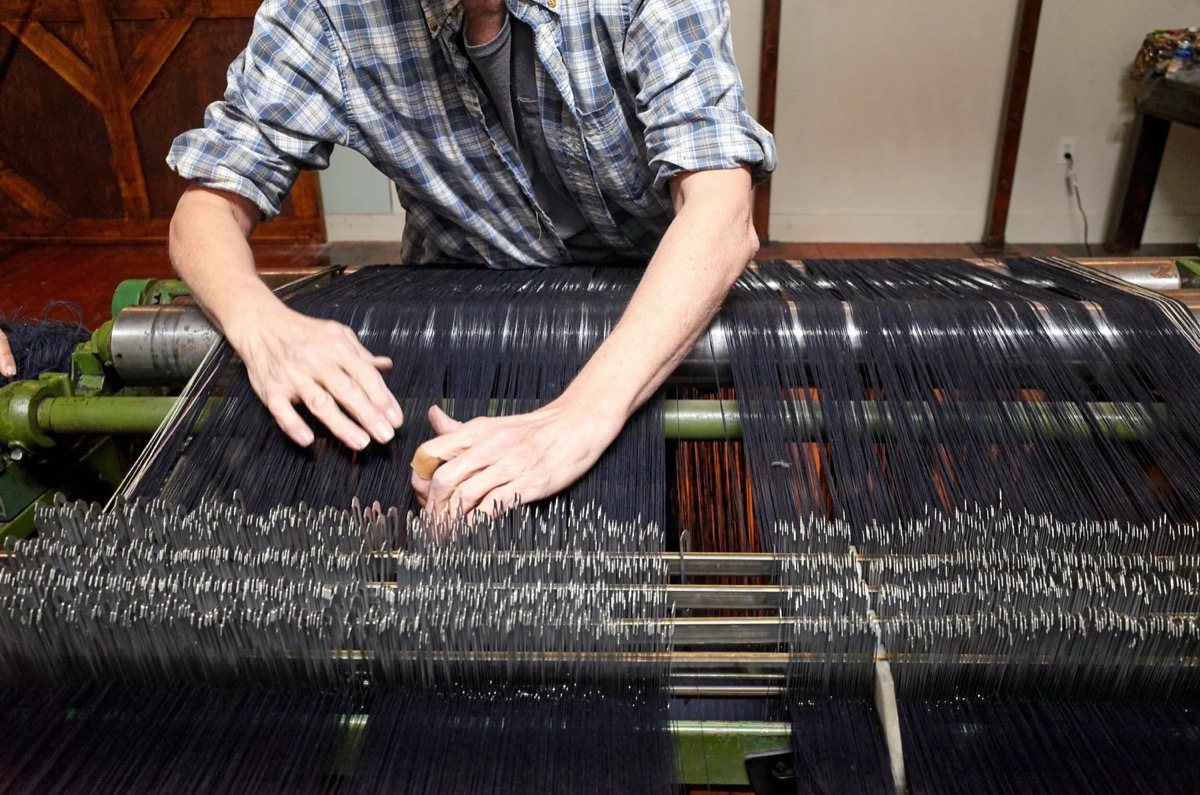
“We’re kind of the caretakers of this knowledge. You can’t take it with you, but you can hold onto it for a little longer.” Evan Morrison
Proximity, Again
The name is the oldest one in Greensboro denim. Moses and Ceasar Cone opened Proximity Cotton Mills in eighteen ninety-five, named, as a nineteen twenty-one Cone publication put it, for being near the cotton. Ten years later they opened White Oak, which became the largest denim mill in the world. Morrison says the plant wove its first order for Levi Strauss in nineteen thirteen and was weaving the XX red line denim by the nineteen twenties. Its looms rode on wooden floors, and Morrison believes the shuttle loom still weaves best that way, settling into a rhythm as the floor gives under it.
The foundation has spent as much effort on the people as on the machines. Its first exhibit, Innovations in Blue, honored Floyd Virgil Hayes, White Oak’s first dyemaster, who standardized the indigo recipe the mill became famous for and who, the foundation notes, was never promoted to a high-level position there; he was Black. W.O.L.F. built the exhibit from research and conversations with his living relatives. And the history keeps coming home in small ways. In two thousand nineteen, visiting Jack King at L.C. King Manufacturing in Bristol, Tennessee, Morrison was handed an original Proximity Denims fabric weight that had arrived with a shipment of cloth from Greensboro more than a century earlier and was still holding down cloth in King’s cutting room. King gave it to him to take home.
003 Unsanforized, Proximity Denim
Hardenco’s high-rise, full-leg 003, made with Hudson’s Hill and always cut from Proximity cloth: about twelve ounces raw, closer to thirteen and a half once shrunk. Shrink it in a hot bath while wearing it, as the makers instruct. Sold by both Hardenco and Hudson’s Hill.
Shop at Hudson’s Hill →
American Denim, by Matt Sharkey
A two-hundred-twenty-four-page photo book, shot on film: White Oak’s last week of production in December two thousand seventeen, the empty plant in two thousand eighteen and the Proximity looms back at work in two thousand twenty-two.
Denim 101
The foundation’s two-day course on spinning, dyeing, weaving and finishing, with visits to the Proximity looms. It has historically run each spring and fall; no new date had been posted at the time of writing.
Go Further
The Bottom Line
Proximity is the smallest denim mill in this publication and in some ways the most important, because of where it is. Two looms, one roll at a time, on the floor where Cone made American denim famous, run by a man who promised to stay home and a weaver who cried on her couch when the call came. It will never replace what White Oak was, and it does not try to. What it keeps alive is the knowledge, and the proof that selvedge can still be woven in Greensboro by people who know how.