
Steven Dang did not come to denim through fashion. He came to it through machines. For about thirteen years he was a mechanic for the Los Angeles Metro, keeping the Gold Line light-rail cars running between downtown and Pasadena, and he had been taking things apart and putting them back together since he was fifteen. When he started buying old industrial sewing machines and rebuilding them in his spare bedroom, it was the same impulse that drew him to engines: the pleasure of making a stubborn old mechanism work again. The jeans came later, almost as a consequence. He had the machines running; he might as well build something with them. He looked up at a train one day, said the word out loud, and Railcar Fine Goods had a name.
The Mechanic Who Rebuilt the Machines
Dang is self-taught, with no formal training in pattern making or sewing. “I came from a mechanical background and started working on cars when I was fifteen,” he has said of the early days. “It was just trial and error.” The trial and error ran on salvaged industrial iron, the heavy single-purpose machines that built American workwear for a century: Union Specials, old Singers, the kind of equipment most factories had long since scrapped. He started with three of them and taught himself what each one was for. A man who can rebuild a commuter train can rebuild a chainstitch machine, and once it runs, it runs for another fifty years.
The trade was in the family in its own way. His father, Sonny Dang, had flown the A-1 Skyraider for the South Vietnamese air force, then became a mechanic, and worked alongside his son at the Metro. Steven built Railcar at home with his partner, Tawny Ortiz, the two of them sewing in a workshop that started in a spare bedroom and spilled into the garage. The ethos that came out of that garage is the one the brand still leads with: Railcar does not make clothes, it builds garments. The verb is the whole point.
A man who can rebuild a commuter train can rebuild a chainstitch machine, and once it runs, it runs for another fifty years.
The Spikes
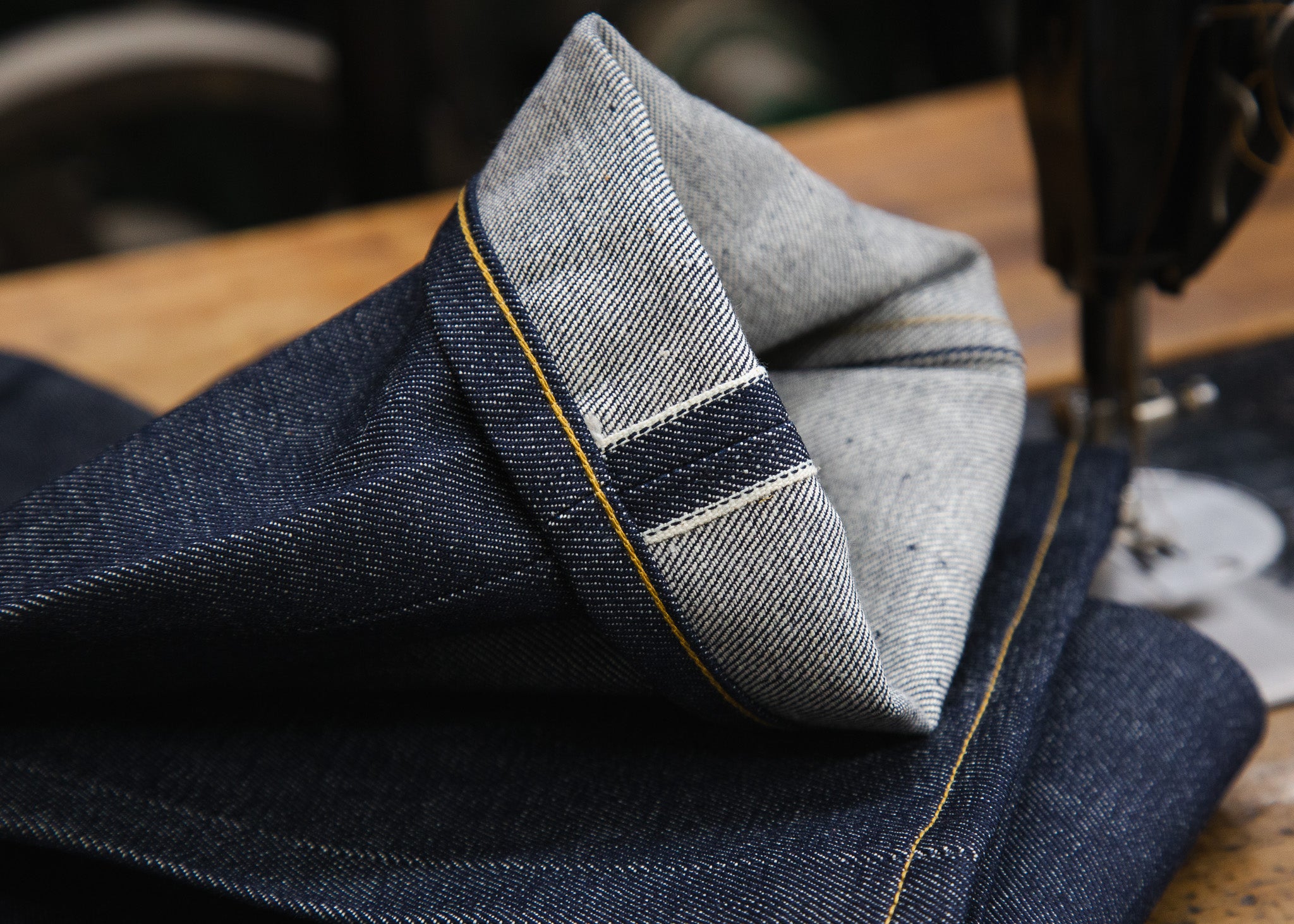
Railcar debuted in two thousand ten, and the jean that started it was the Spikes. It was a slim, straight cut built on heavyweight American selvedge, woven at Cone Mills with the red selvedge line that collectors prize, and it sold for just under two hundred dollars at a time when that bought you a great deal of denim credibility for the money. The heritage-denim press noticed early. The cut was clean, the construction was honest, and the back story, a train mechanic sewing jeans on rebuilt machines in his house, was exactly the kind of thing the small but devoted raw-denim world wanted to root for.
There was no viral moment, no single segment that lit a fuse. Railcar grew the way Dang did everything else, incrementally and by hand. The Spikes is still in the line today, fourteen years on, and it remains the spine of the catalog. The model numbers that denim obsessives trade in, the X001 that started it and the X130 that anchors the line now, are simply the lots of cloth, logged the way a mechanic logs parts.
Eight Years of Graveyard Shifts
The romantic version of a one-man denim brand leaves out what it costs. For roughly eight years, Dang ran Railcar on no sleep. He worked the Metro graveyard shift, from about half past nine at night to half past six in the morning, then came home and built jeans through the day, napping on a cot he kept under the screen-printing press. He did not go full time on Railcar until around two thousand fifteen, when the brand could finally carry him. That is five years of holding down a railroad job and a jeans company at the same time, on a schedule that would have broken most people who tried it for a month.
He nearly compromised once on the thing that mattered most. Early on he tried sending some production out to an outside factory, the obvious move for a small label that wants to grow, and the quality came back wrong. So he pulled all of it back in-house and resolved to keep every step under his own roof, where he could watch it. That decision dictated everything that followed, including a slow climb through bigger and bigger spaces: the home garage in two thousand ten, a small office, a roughly one-thousand-square-foot shop in Arcadia, then a four-thousand-square-foot workshop in Monrovia in two thousand fourteen. In two thousand twenty, in the middle of the pandemic, Railcar moved again, into a thirteen-thousand-square-foot building from nineteen twenty-seven in El Monte, where it makes everything today.
One Roof in El Monte
Walk into the El Monte shop and you see the argument the brand makes with its hands. The patterns are drafted there, the cloth is cut there, and the garments are assembled there by a small in-house team on manual and vintage machines, with nothing automated. Each piece is built start to finish by people in the same building, which is the level of care that left American garment making decades ago and is genuinely hard to find now. When Railcar says it builds rather than makes, this is what it means: a room full of old machines that someone keeps running, and a crew that knows how to use them.
The cloth is the honest, complicated part. Railcar built its name on Cone Mills White Oak selvedge from North Carolina, the most storied denim America ever wove. When White Oak closed at the end of two thousand seventeen, Railcar did what the best small makers did and went looking for the next best thing. It partnered with Vidalia Mills in Louisiana, which bought Cone’s old Draper looms and now weaves selvedge on them, and it sources Japanese selvedge from Kaihara and Italian denim from Candiani for particular fabrics. So the denim travels, and Railcar says as much, describing its raw materials as globally sourced. What never leaves California is the making.
The compounding came the slow way too. The Spikes grew into a family of fits, the line widened into denim jackets, shirts, aprons, tees, and leather goods made on the same floor, and a steady alterations and repair service grew up alongside the new garments, tapering and chainstitch-hemming jeans for people who wanted to keep them for good. In two thousand twenty-five Railcar went one step further into its own roots with Railcar Black, a small made-to-order line hand-built on hundred-year-old machines in deadstock Cone White Oak, the closest the brand comes to bespoke and the clearest statement yet of what Dang has been chasing since the spare bedroom.
Spikes X130 Taper
The jean that started it all, now in a fourteen-ounce classic indigo selvedge with a tapered leg. Cut and sewn in El Monte, it is the whole Railcar story in one pair.
Type 2 X130 Jacket
The classic trucker silhouette on the same indigo selvedge as the Spikes, made to fade alongside the jean. For the buyer who wants the full denim-on-denim rig.
Impala Cotton Flannel
A Japanese-milled stripe flannel cut and sewn in the same shop, an easier and cheaper way to own something Railcar actually builds.
Go Further
The Bottom Line
Railcar Fine Goods is what happens when a mechanic decides clothes are just another machine worth keeping alive. Steven Dang rebuilt the old industrial machines, taught himself to sew on them, and worked eight years of graveyard shifts to keep a jeans company breathing. The cloth comes from a few mills now, at home and abroad, but the cutting and the sewing have never left one California room, built one garment at a time by the people standing in it.