The story Round House tells about its own beginning is too good to be true, and the company tells it anyway. Around the turn of the twentieth century, by an account it traces to a 1910 issue of the Shawnee Daily Herald, an itinerant tailor wandered into Shawnee, Oklahoma with four sewing machines. The mayor put him and his machines to work making bib overalls for the men of a booming railroad town. Business took off, and so did the tailor, who ran away with his landlord’s daughter and was never heard from again. The townspeople kept the machines running. Whatever the literal truth of it, the shape of the thing is right: a small factory, started in 1903 to clothe people doing hard work, that simply never stopped. More than a hundred and twenty years later it is still in Shawnee, still making the same overall, and still owned by a family that has held it for three generations.
A Factory Named for the Railroad
Shawnee in 1903 was a railroad town in the fullest sense. By the company’s account more than a hundred trains roared through every day, and thousands of railroad workers passed through with them, building toward the country’s westward expansion. The factory, first incorporated as the Shawnee Garment Manufacturing Company, made the clothes those men worked in, and it took its lasting name from the building at the center of their world: the roundhouse, the circular depot where locomotives were turned and repaired. Round House overalls became a favorite of the rail crews, and the name stuck to the company for good. The why was the same one that runs underneath every maker in this series. People doing physical work needed clothing tough enough to survive it, and someone had to make it within reach of where they lived.
It took its lasting name from the building at the center of a rail crew’s world: the roundhouse, where locomotives were turned and repaired.
The Bib Overall
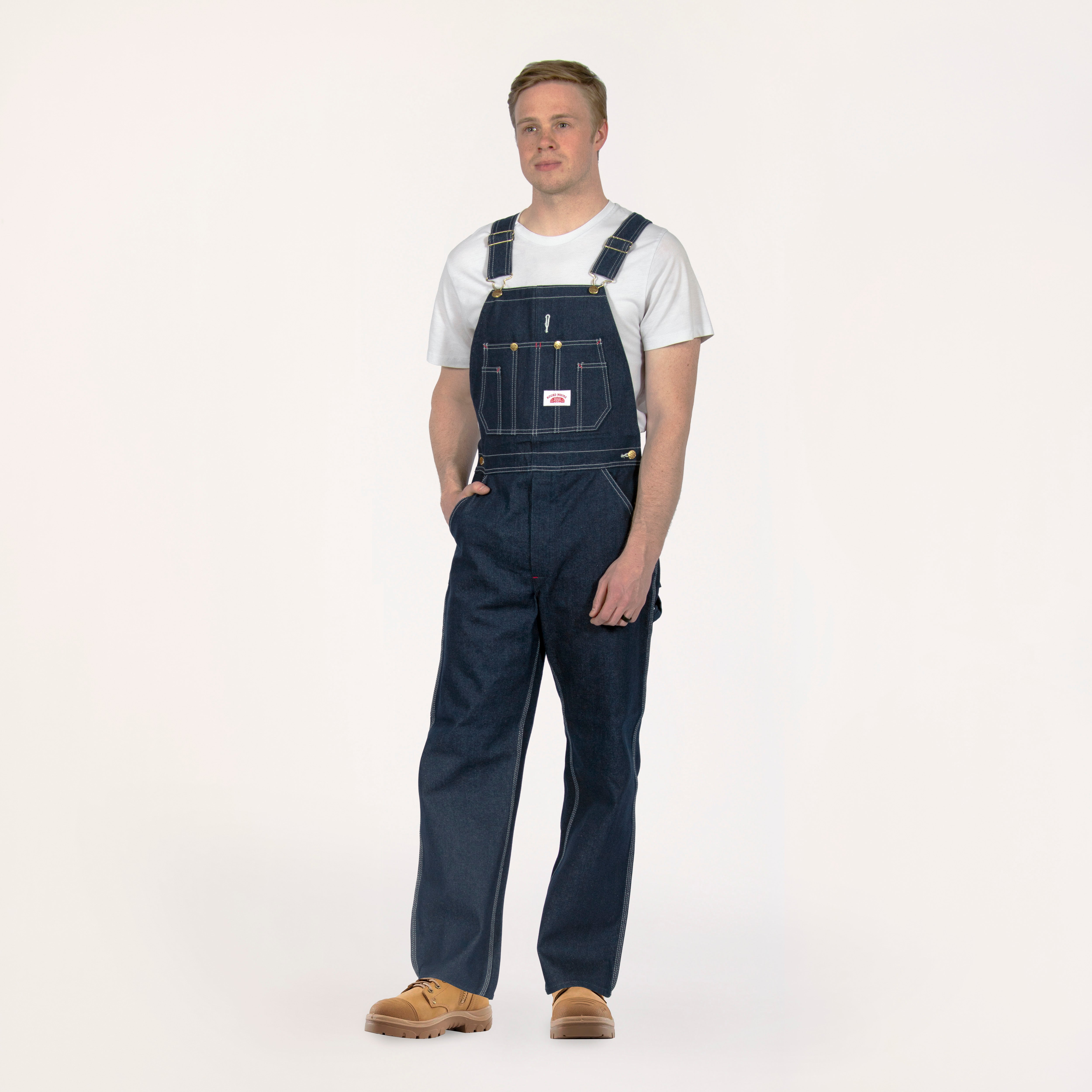
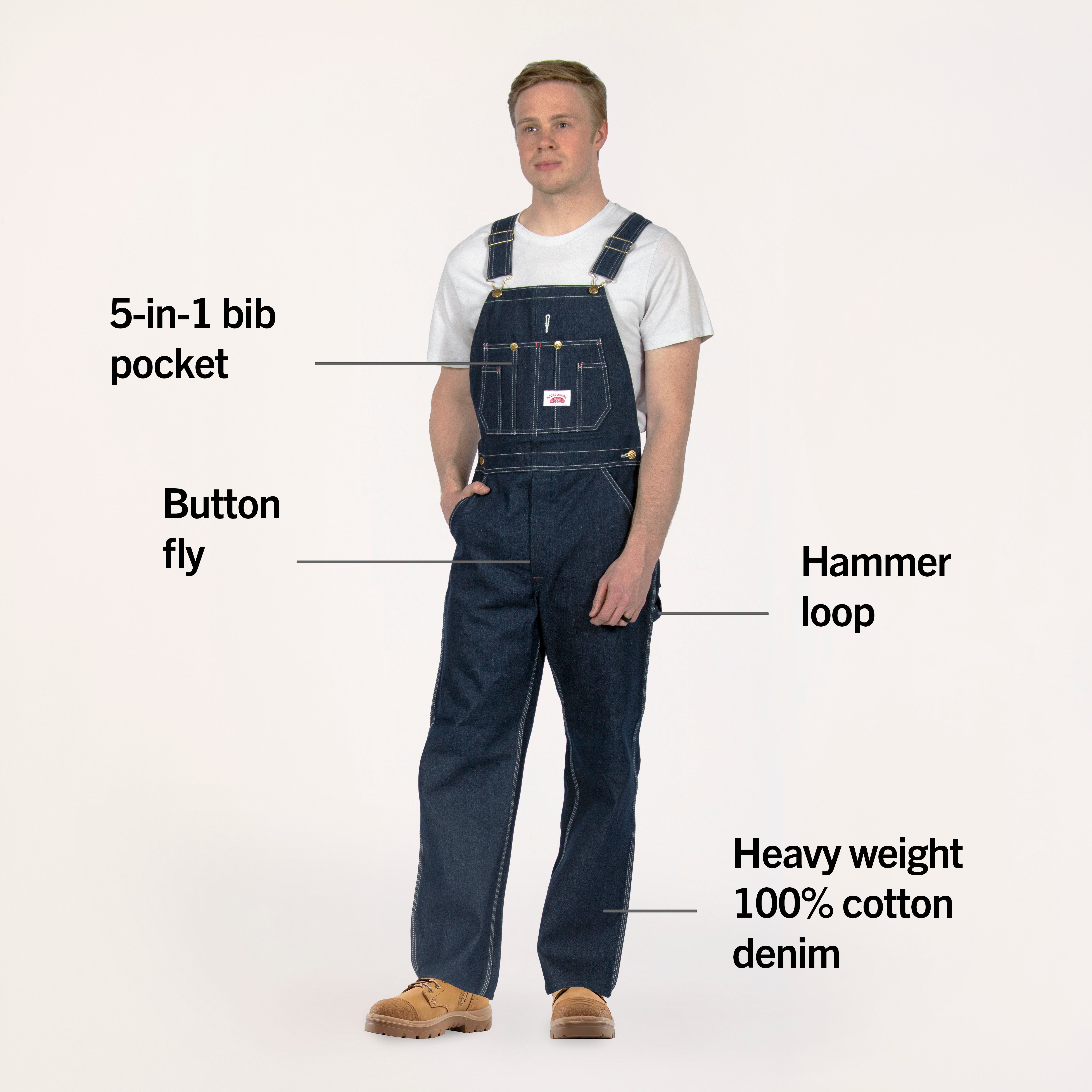
The product that lit the company was the bib overall, and it remains the thing Round House is known for. The construction is the entire pitch. A heavyweight cotton denim, a generous bib with a multi-compartment pocket, a hammer loop, rust-proof hardware, and contrast stitching run flat against the indigo. None of it is styling. Each piece is there because an overall that failed on the job was an overall the company would hear about from the man wearing it. The most distinctive version is the one almost nobody else still bothers to make: a true button-fly bib. The brand says plainly that button-fly overalls are far less popular than zipper-fly ones, and that Round House is the only company still producing them, in limited sizes and quantities, for the buyers who want the old way. It is a small, stubborn detail, and it tells you most of what you need to know about the place.
From Overalls to a Full Workwear Line
What started as overalls compounded, over decades, into a full closet of American workwear: five-pocket jeans, carpenter and double-front dungarees, work jackets, shirts, and jumpers, in indigo denim and brown duck. The company grew with the country it dressed. In the Second World War it turned its lines over to making khakis for the United States Army. Through the long postwar decades it kept widening the catalog while almost everyone in the American garment trade was preparing to leave it. By the company’s own count it now turns out roughly three hundred thousand garments a year and serves more than two thousand retailers, and it exports its American-made goods to Asia, Europe, and Australia, with Japan a notably devoted market for the real thing. In 2011 the state recognized the obvious and named Round House its Exporter of the Year. The little overall shop had become, in its own description, the largest maker of American-made jeans and overalls in the world.
As far as work clothing, we’re about it, so it gives us a real niche.
The Arithmetic of Staying
The hard part of the Round House story is not a fire or a bankruptcy. It is the slow, grinding pressure that emptied the American garment industry out from under it. As the rest of the trade chased cheap labor offshore through the closing decades of the century, the competitors that had once filled the workwear aisle disappeared one by one, and Round House was left as very nearly the last of its kind still sewing this clothing at home. Jim Antosh, who has run the company since 1986, puts the upside of that survival simply. “As far as work clothing, we’re about it,” he has said, “so it gives us a real niche.”
Survival has a price, and the company is unusually honest about paying it. In a 2025 NBC News report on American-made denim, David Antosh, Jim’s son and the third generation in the business, laid out the arithmetic without flinching: a pair of Round House jeans sewn in Oklahoma sells for around seventy dollars at a margin of roughly five percent, a thin enough sliver that the American line is effectively carried by the company’s imported goods. That is the trade-off, stated plainly. To keep American sewers at their machines in Shawnee, Round House also sells lower-cost imported product, and uses the wider business to subsidize the domestic one. It is not the tidy story a marketing department would write. It is the actual mechanism by which an American factory in a small Oklahoma town is still open in 2026.
Made in Shawnee, and the Asterisk on the Cotton
The made-in-USA claim at Round House comes with a clear boundary, and the company draws it for you. Everything sold on its own website, round-house.com, is made in the United States, cut and sewn in Oklahoma: at the modern Shawnee plant the company moved into in 1995, and at a second plant opened in nearby Wewoka in 2008 for its non-bib denim pants. The same garments carried by some third-party retailers, the company says directly, are not made in America, a concession it makes in order to keep stores stocked across more than two thousand sizes. The honest version, then, is specific: buy the Oklahoma-sewn product from the source, and you are buying American hands.
The cotton carries its own note. Round House states that it uses United States cotton on every item, whether the garment is sewn in the USA or sewn abroad, and its denim has long been milled in America. The link the company does not publish is the mill that weaves its cloth today. For years its denim came from the American Cotton Growers mill in Littlefield, Texas, woven from regional cotton, but that mill closed in early 2015, and no current source names which American weaver supplies Round House now. The specific cotton farm is not published either. We mark the cotton and the weaving as reported, on the company’s word, and confirm only what can be confirmed: the cutting and sewing, which happen in Oklahoma.
The Oldest Factory in Oklahoma
The lineage at Round House is not a revival assembled from a closed mill’s parts. It is an unbroken line, and a long one. The company calls itself the oldest operating manufacturing company in Oklahoma, and the dates back it up: founded in 1903, four years before Oklahoma joined the union, it has run continuously ever since. It passed through the Nuckolls family, who built it up in the early decades, and the Truscotts, who bought it in 1938, before Edward Antosh purchased the company in 1964 and made it the family business it still is. Edward’s son Jim took the presidency in 1986; Jim’s son David is the third Antosh generation on the job. Three generations of one family, more than sixty years at the helm, in a single American town. The heritage is not framed on a wall. It is the same factory making the same button-fly bib for the same reason it always did, kept alive by a family that decided staying was worth the thin margins it costs.
#327 Button-Fly Bib Overalls
The garment the company was built on, in its rarest form: a true button-fly blue denim bib, made in limited sizes because almost no one else makes it at all. Heavyweight cotton denim, a multi-compartment bib pocket, a hammer loop, rust-proof hardware. For the buyer who wants the single most Round House thing in the catalog. Cut and sewn in Oklahoma.
#103 Made-in-USA Five-Pocket Jean
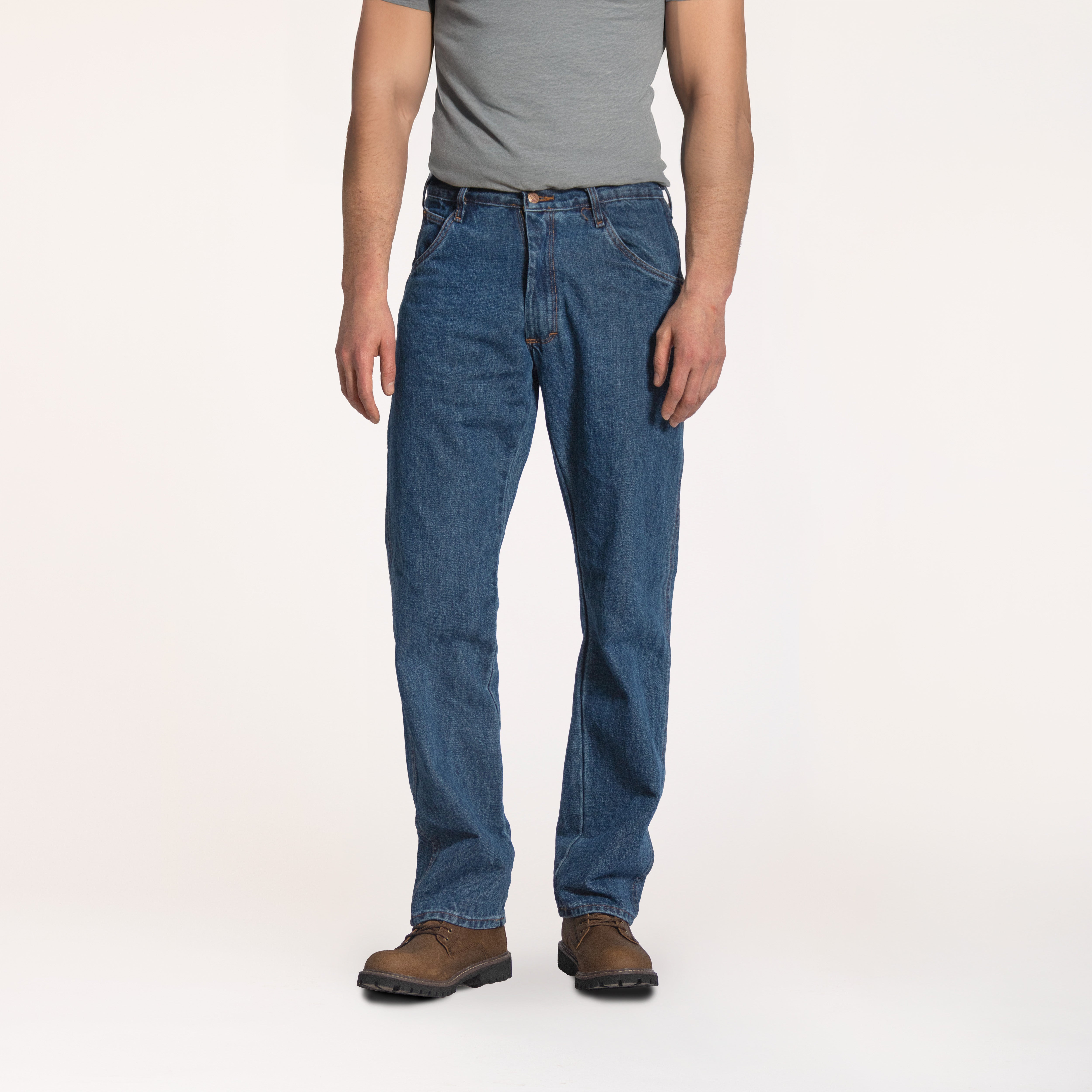
A fourteen-ounce, dark-stone-washed, all-purpose five-pocket jean in a relaxed fit, the American-made workhorse of the line. The honest seventy-dollar made-in-USA jean the company sews in Shawnee. For the buyer who wants a domestic everyday pair at a working price.
#1010 Carpenter Dungaree
A fourteen-ounce double-front carpenter dungaree with a hammer loop and tool pockets, dark stone washed, built for the trades and sewn in Oklahoma. For the buyer who actually works in their clothes, or wants the cut that was made for it.
Go Further
The Bottom Line
Round House is the workwear version of the survivor story: not a brand reviving American manufacturing, but one that simply never quit it. A railroad-town overall shop from 1903, run by one family for three generations, still sewing the button-fly bib almost no one else will. What makes it worth your attention is its honesty about the cost. The American line runs on thin margins, carried in part by imported goods, because keeping sewers at their machines in Shawnee is the thing the Antoshes decided not to give up. The overalls are made where they were always made. The company tells you exactly what that takes.