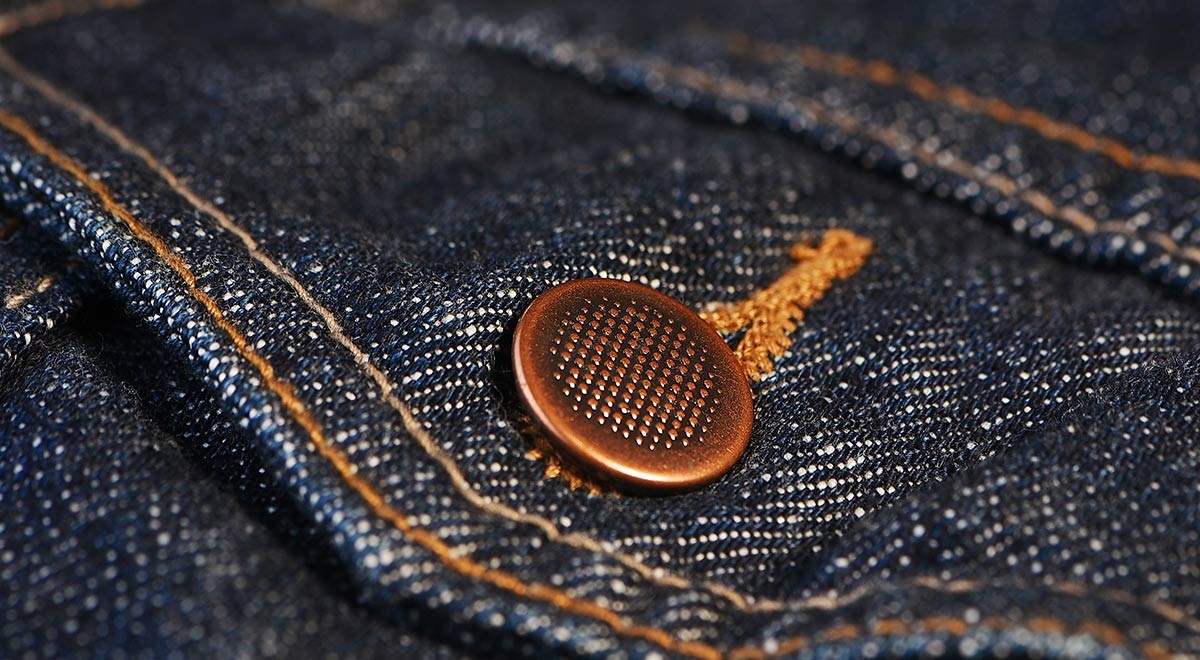
There is a test you can run on almost any jean in this publication. Find out where the cotton grew. Find the spinner, or try to. Find the mill and the year the looms were built, find the factory and the name of the person who sewed it. Then turn the waistband over and look at the button, and the record goes silent. Twenty-six maker profiles have mapped cotton, yarn, cloth, thread, leather and labor. Not one has been able to say who made the hardware, because essentially no brand publishes it. The button is the last anonymous part of the jean.
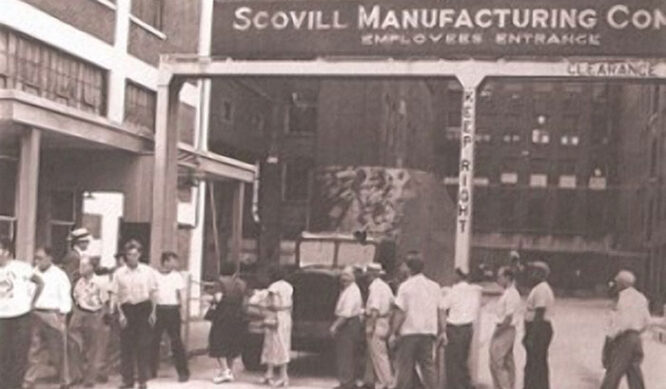
It is also, improbably, the oldest. The company most likely to have made it was founded in eighteen hundred and two, which makes it older than the jean, older than the sewing machine, older than the state of Alabama. It has outlived every mill in this publication, including Cone. It is called Scovill, it sits on thirty-one acres in Clarkesville, Georgia, ninety miles northeast of Atlanta, and its street address is 1802 Scovill Drive.
Two Brothers and a Pile of Old Kettles
The company did not begin with anyone named Scovill. In eighteen hundred and two two brothers from Southington, Abel and Levi Porter, moved to Waterbury and went into business with three pewter button makers, Henry, Silas and Samuel Grilley, under the name Abel Porter and Company. What they built was the first rolling brass mill in the United States, and the way they fed it says everything about how American manufacturing actually starts. They bought up old copper kettles and stills, melted the metal down, alloyed it with zinc, shipped the ingots to iron mills in Litchfield to be rolled into sheet, hauled the sheet back to Waterbury, and finished it on steel rollers turned by a horse.
The Porters were probably the first Americans to make brass by fusing zinc and copper directly rather than importing the alloy. They did it to make buttons. Everything that Waterbury became, the Brass City, the Brass Valley, a hundred and fifty years as the world capital of a metal, came out of a button shop that ran on scrap cookware and one horse.
The Scovill name arrives in eighteen eleven, when a new partnership formed around Doctor Frederick Leavenworth, David Hayden and James Mitchell Lamson Scovill. A new button shop went up in eighteen twelve, and its timing was not an accident. The company took government contracts for pewter shank uniform buttons for the Army and the Navy in the War of Eighteen Twelve, and that is the beginning of a run with no real parallel in American industry: Scovill buttons were on United States military uniforms in every war of the nineteenth century and every war of the twentieth.
In eighteen twenty-seven Lamson Scovill and his younger brother William Henry took control of the business and ran it as J.M.L. and W.H. Scovill. Their partnership had the shape that small manufacturers still recognize. Lamson traveled and sold. William Henry stayed home and ran the place. The company’s own account of him is three words long and better than most modern job titles: the planner, the organizer, the man-at-home.
By eighteen sixty-four a single machine on the Waterbury floor could turn out two hundred and sixteen thousand buttons a day.
They incorporated as Scovill Manufacturing Company in eighteen fifty, on roughly three hundred thousand dollars a year in sales, and kept sixty percent of it. One thing from the early years is worth pulling out because it is so strange. In eighteen twenty-five, when the Marquis de Lafayette toured the United States, Scovill made him a set of gold closures stamped with the head of George Washington. There were seventeen of them and, by the company’s account, all seventeen were cut from a single gold nugget mined in North Carolina. A button shop in Connecticut, a Carolina gold nugget, and the last living general of the Revolution.
The Company That Made Everything
A button is a small stamped metal disc, and a company that can stamp one can stamp almost anything. Scovill worked that logic for a century. It made brass lamps. It made munitions and artillery fuses. It made the sensitized metal plates that daguerreotype photographers exposed in the eighteen forties and fifties, which is why the company turns up in the history of American photography as often as in the history of clothing. It made coin blanks for the United States Mint.
War kept accelerating it. Annual sales were somewhere between seven and eight million dollars going into the First World War. By nineteen fifteen they were thirty-four million. Two years after that, fifty-eight million. Then in the twenties it bought its way sideways into the rest of American life: the American Pin Company and the Oakville Company in nineteen twenty-three, then Hamilton Beach, the mixer and appliance maker, and Gilchrist and Company, which built soda fountain equipment. By the middle of the century Scovill was a diversified industrial conglomerate that happened to have started with buttons, and eventually it owned Yale locks and NuTone as well.
Its two lasting contributions to clothing came in this stretch and both are still in production. The Gripper snap, a light fastener that changed how infant clothing was made, and DOT, a heavy industrial snap introduced more than a hundred years ago and now standard on boat covers, tactical gear and military equipment. DOT fasteners were on the Apollo Eleven crew’s uniforms at the moon landing in nineteen sixty-nine. Decades later, Scovill’s own securities filings would describe a product line running from military uniforms in the War of Eighteen Twelve to the flight suits worn by Space Shuttle astronauts, which is an unusual sentence to find in a form 10-K.
Sold for Parts
Being a conglomerate in the nineteen eighties was a diagnosis. Scovill was a collection of good businesses trading below the sum of what those businesses would fetch separately, which in that decade meant it was not a company so much as an inventory. In nineteen eighty-five it was acquired by First City Industries, the American arm of the Belzberg family’s Vancouver holding company, in a deal reported at figures ranging from five hundred and twenty-three million to seven hundred and forty million dollars. The new owners then did what the arithmetic told them to do. They sold the pieces. Two subsidiaries alone went for six hundred and sixteen million; contemporary reporting put total proceeds from Scovill asset sales near eight hundred and ninety-three million. NuTone was gone by nineteen eighty-seven. Hamilton Beach went. Yale went.
What was left when the sale finished was the original business. Buttons and snaps. The thing the company had been doing since the horse turned the rollers.
Then it left. In nineteen ninety-one Scovill bought the DOT industrial fastener line from TRW and consolidated all of that manufacturing into a plant it had opened in Clarkesville, Georgia, back in nineteen fifty-three, and the Waterbury operations went dark. In July of nineteen ninety-seven the corporate headquarters followed, ending a hundred and ninety-five years in the city Scovill had helped invent. That November, management bought the company from Kohlberg and Company with backing from Saratoga Partners.
The ending in Connecticut is almost too neat to print. On the seventeenth of September, nineteen ninety-seven, ten weeks after the headquarters moved south, a shopping mall opened on the site of the Scovill Brass Works in Waterbury. It is called the Brass Mill Center. Building it required removing sixty-three vacant and deteriorating buildings and a hundred and eighteen thousand tons of contaminated soil from eighty-seven acres beside Interstate 84. The company that made the Brass City left, and the ground it stood on had to be hauled away before anything else could be put there.
What a Tack Button Actually Is
The hardware on a pair of jeans is not one part, it is a small system, and it is worth understanding because it explains why this step in the chain is so hard to displace. A jeans button is a tack button: a face, and behind the fabric a tack or post that is driven through the denim and swaged into the back of the face under several hundred pounds of pressure. A rivet is the same idea at pocket corners, a cap and a post clinched through the cloth. A burr is the washer-like back that some constructions clinch against. None of them is sewn. All of them are cold-formed metal, set by a machine, and once set they are meant never to come off.
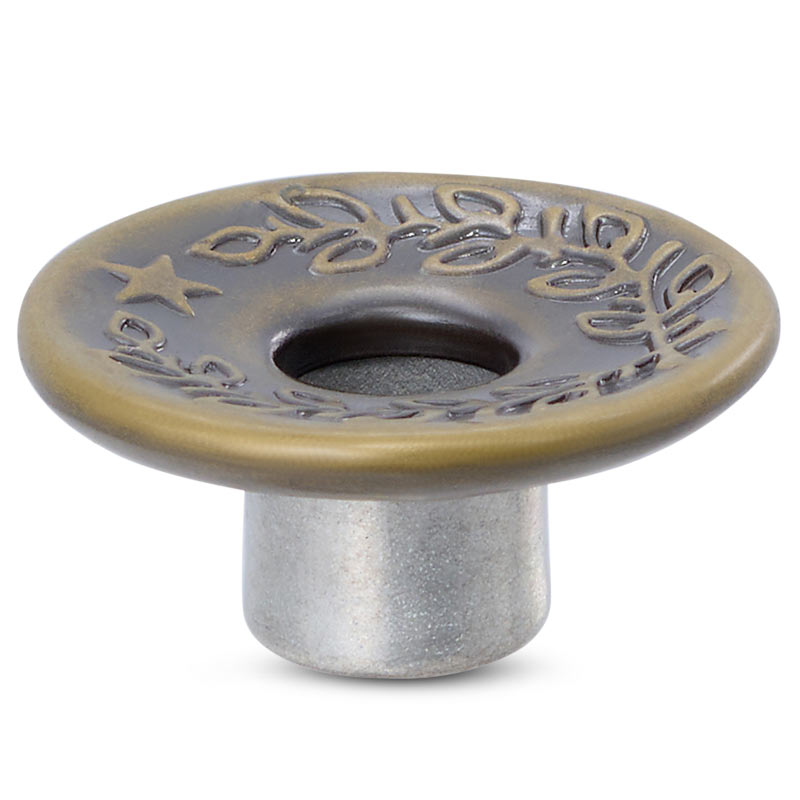
Scovill sells these under the Duramark name, in brass, stainless and plastic-backed constructions, in more than three hundred standard finishes, with lacquers specified to survive industrial washing. The company’s jeanswear line is buttons, burrs, snaps and zippers, and its description of what they are for is the plainest thing on the site: from button-fly to traditional denim, jean-jackets, shirts, jeans and overalls.
The part that matters commercially is not the button. It is the machine. Scovill does not simply sell a factory a box of hardware; it puts the attaching press on that factory’s floor, on lease, and maintains it. Its nineteen ninety-seven annual report describes roughly eight thousand proprietary attaching machines out in customers’ plants, serviced by what the company believed was the industry’s only dedicated field service force. Sell the button and you have a sale. Lease the press that sets the button, tool it to that button, and service it, and you have the customer. That is the reason a two-hundred-year-old fastener business is difficult to compete with, and it is also the reason no brand ever mentions it. The relationship happens between the hardware company and the factory. The label never learns about it.
Who Was Actually Buying
Because Scovill issued public debt in the late nineties, it had to describe its business under oath, and that filing is the single most useful document about this company that exists. In the year ended the thirty-first of December, nineteen ninety-seven, Scovill sold more than twelve billion fastener units worldwide. It employed eight hundred and eighty-six people, seven hundred and fifteen of them in manufacturing, none of them unionized at Clarkesville. Its American operation was a two hundred and thirty thousand square foot manufacturing and administration building plus a twenty-six thousand four hundred square foot attaching machine center on thirty-one acres in north Georgia.
And it named its customers. The apparel side listed Wrangler, OshKosh B’Gosh, Gerber Childrenswear, the William Carter Company, Tommy Hilfiger, Polo Ralph Lauren, Liz Claiborne and L.L. Bean. That is the answer to the question this publication keeps failing to ask. For a generation, if you bought a mass-market American jean, the odds were good that the button holding it shut came out of Habersham County, Georgia, and nobody ever told you.
Bankruptcy, and a Japanese Owner
The nineties debt did not end well. On the tenth of June, two thousand eleven, the United States Bankruptcy Court for the District of Delaware approved the sale of substantially all of Scovill’s assets to The Gores Group under Section 363 of the bankruptcy code. The press release announcing it is careful and a little wistful, describing a company that had made snap-closure buttons for consumer and military clothing since eighteen hundred and two and crediting its employees rather than its balance sheet.
Scovill employees have a great history and reputation for providing customers with top-notch quality products and services.
Three years later the private equity owner sold it on. In October of two thousand fourteen, Morito Company Limited of Osaka, Japan, a maker of apparel fasteners, automobile components and camera parts, bought Scovill Fasteners. Morito’s existing American subsidiary, Kane-M, was folded in, and the business became Morito Scovill Americas, still trading as Scovill Fasteners, still at 1802 Scovill Drive. Morito’s president at the time, Takaki Ichitsubo, called it part of a global growth strategy. It is now run by Bunki Yano as president, with Shane McEntyre, a lifelong Habersham County resident who has been with the company more than three decades, as chief sales officer.
It is worth sitting with what that sequence means. The oldest manufacturing name in American apparel was broken up by a Canadian raider, driven out of its home state, run into bankruptcy, sold at a court-supervised auction to a Los Angeles private equity firm, and then bought by a Japanese components maker. It is still making things in Georgia. Every one of those things is true at once, and the reindustrialization story does not get to pick which ones to keep.
Where It Is Made
Scovill states its manufacturing position in one line at the top of its own homepage: ninety percent of Morito Scovill Americas products are manufactured in the USA. Alongside it the company counts sixty million pieces produced each week, hardware going into five million garments a week, and Berry Amendment compliant products for military applications. That last item carries the most weight of the four, because the Berry Amendment is not marketing. It is a federal procurement statute requiring that clothing and textiles bought for the armed forces be wholly of American origin, down to the components, and a supplier that ships against it is subject to audit on exactly the question this publication cares about.

The qualifications are real and should be stated. The ninety percent figure is the company’s own and has not been independently audited. Morito Scovill Americas also runs or draws on operations in Hong Kong, Mexico, Japan, China, Taiwan, Vietnam, Thailand, the Netherlands and France, and it does not publish a breakdown of which items in the catalog come from where. The raw brass is not traced. And there is no current customer list, so this publication still cannot point at a specific jean on sale today and say that button was made in Georgia. What can be said is considerably more than could be said a week ago: the largest apparel fastener manufacturer serving the United States operates a real metal-forming plant in north Georgia, claims the overwhelming majority of its output from it, and holds itself to a federal domestic-content standard on the military side of that output.
Back to Connecticut
Three weeks ago Morito Scovill Americas announced it had acquired Edward Segal, Incorporated, of Thomaston, Connecticut. Segal has built eyelet, grommet, rivet and snap attaching machines and custom automated assembly systems since nineteen forty-two, in the United States, and will keep operating with its existing team. Terms were not disclosed. David Segal, the company’s president, framed it as an opportunity for his employees and customers; Bunki Yano framed it as a customer-centered move; Shane McEntyre called it an important strategic step.
Read it against the rest of the story and it is something better than a press release. Scovill left Connecticut in nineteen ninety-seven after a hundred and ninety-five years, and the ground its factory stood on was excavated and turned into a mall. Twenty-nine years later, the same company, now Japanese-owned and headquartered in the north Georgia mountains, bought an American machine builder twenty miles from the old Waterbury works. Thomaston is in Litchfield County. It is where the Porter brothers used to send their brass to be rolled.
And the thing it bought is the right thing. The attaching machine is the piece of equipment that a reshoring cut-and-sew shop has to have and cannot easily improvise, the press that sets the button, and it is now owned by the hardware company and still built in the United States. Of everything in this profile, that is the part that most resembles the chain being repaired rather than merely surviving.
DOT Durable snap fastener set
Scovill sells its industrial line direct to the public through its own DOT store. Not the denim tack button, which is only sold to factories, but the same hardware family from the same company, in cloth-to-cloth and cloth-to-surface sets with the tooling. The way to hold a piece of this in your hand.
All American Clothing AA101
The plainest American jean in this publication and the only one that reports its buttons and zippers as domestically made along with the cotton, the denim and the sewing. The hardware maker is still unnamed, but every other step is on the record.
Round House #327 bib overall
A true button-fly bib sewn in Shawnee, Oklahoma, and the garment in this publication with the most fasteners on it: fly buttons, bib buckles, rivets at every stress point. If you want to look closely at how tack hardware is set, buy the thing covered in it.
Go Further
The Bottom Line
The hardware leg turns out to be in better shape than the cloth leg, which almost nobody would have guessed. Cone is gone and Vidalia is gone, but the company that made the button outlasted both, and it is still cold-forming metal in Georgia and now building the presses in Connecticut again. The failure here is not manufacturing, it is disclosure. Every brand in this publication will tell you the mill, the ounce weight and the sewing floor, and not one will tell you who made the button, which means the single oldest surviving link in the American chain is also the only one nobody gets credit for.