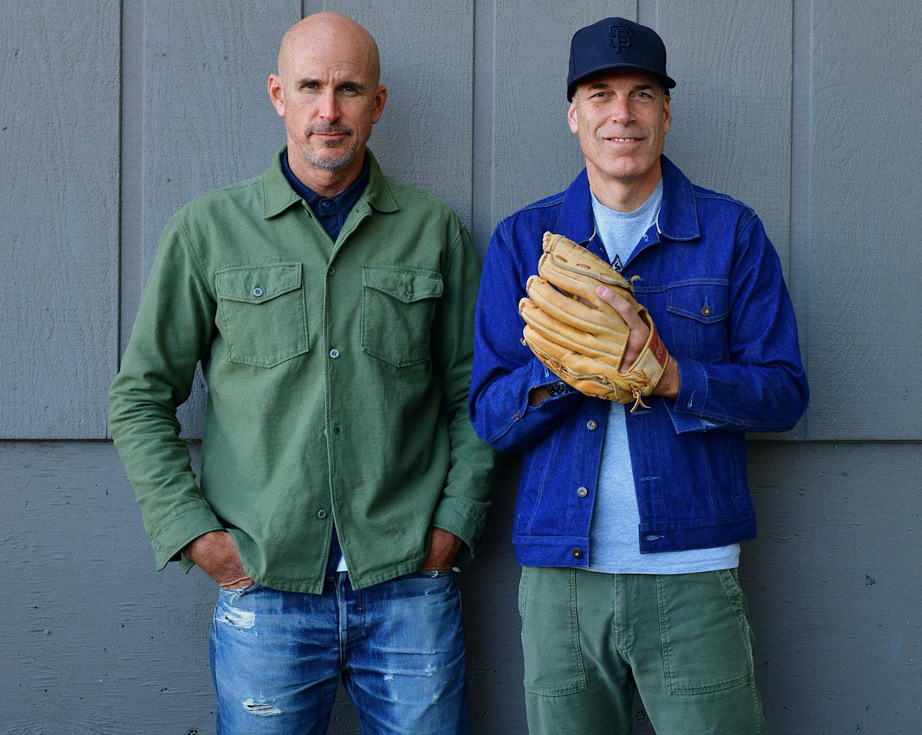
Tony Patella and Pete Searson were born two weeks apart in nineteen sixty-five, one in Germany to a serviceman’s family, the other in Long Beach. They grew up three hundred miles apart on the same California of skateboards, surf, and punk records, and when they finally met in nineteen ninety, Pete a young Mossimo salesman walking into Tony’s family sporting goods store, they figured out fast that they had, as they like to put it, been sharing the same closet their whole lives. Eighteen years later they went into business together, and the business was a pair of blue jeans. They called it Tellason, a plain welding of their two last names, and they built it on a promise that sounds almost stubborn now: the jeans would be made in San Francisco, and only in San Francisco, for as long as the company existed.
Two Kids From California
The denim know-how came from Tony. Through the nineteen-nineties he had been a partner in a San Francisco denim label, Sutter’s, working alongside a veteran of the trade named Cliff Abbey, and in those years he learned the whole of how a pair of jeans is built, from the sample line to the sewing floor. He also met the people who would matter most later: a small cut-and-sew contractor in San Francisco, a father and daughter who had started a factory with a couple of machines between them. Pete’s side was the commercial one, a career in apparel sales and distribution. One knew how to make the thing; the other knew how to move it. They were, between them, a whole company waiting to happen.
What they shared was a taste, and it was narrow on purpose. Skateboarding and punk had taught them to distrust frills, and they wanted to make the opposite of fashion: high-quality basics, nothing embellished, nothing that would look dated in a decade. Tony has a line about it that doubles as a mission statement. His father and Pete’s, both children of the nineteen-fifties, turn up in old photographs in rolled raw denim, white tees, and Chuck Taylors. “I’m wearing the same thing today,” he says. The brand was never trying to invent a look. It was trying to keep one alive.
The First Phone Call
It was two thousand eight, the economy was sliding into the worst recession in living memory, and retail was on its back. To Tony and Pete this read, somehow, as the right moment. If a brand could earn trust when nobody was spending, it could earn it for good. The very first call they placed was to the San Francisco offices of Cone Mills, the legendary North Carolina weaver, where Tony’s name from the Sutter’s years still carried weight. They bought a run of White Oak selvedge on the strength of that name, went back to the same sample line Tony had used before, and started fitting a jean.
The making of it was almost comically hands-on. Pete would pull a sample on right there on the factory floor, Tony would mark the changes, the sewer would adjust, and they would do it again. After four pairs they had the one. They spent the better part of a hundred days getting it right, then shipped their entire first collection: two hundred and forty pairs of a single slim-straight jean. They gave it a name that told you everything about where they came from. It was the John Graham Mellor, after the man the world knew as Joe Strummer of the Clash. Neither founder took a salary. They kept their day jobs in apparel and poured every dollar back into the next run.
Their entire company, in year one, was two hundred and forty pairs of one jean named for a dead punk.
One Jean Becomes a Line
The way the line grew tells you how the company thinks. Tellason did not chase a season; it answered its customers. A retailer in Amsterdam reported that buyers there kept taking the John Graham Mellor to a tailor to have the leg tapered about two inches below the knee, so Tellason simply made that jean and named it the Ladbroke Grove, after the West London streets that ran through the Clash’s songs. From two cuts came the rest, slowly: a denim Coverall jacket that became a quiet icon among collectors, raw chambray work shirts, chinos, a sweater here and there. From two thousand ten they began developing their own proprietary fabrics with Cone rather than ordering off the shelf.
None of it changed by season, and that was the point. The same jeans, made the same way, in the same place, year after year, so a customer who loved a pair in two thousand twelve could replace it in two thousand twenty and get the same thing. That patience found a surprisingly wide market. By the brand’s tenth year roughly seventy percent of its sales were overseas, with stockists in Japan, Germany, Switzerland, Belgium, and the United Kingdom, denimheads who prize exactly the things Tellason refuses to compromise. The jeans landed at around two hundred and thirty dollars, a price the founders held as low as an honest American-made jean can go.
When White Oak Went Dark
For nine years the cloth was never in question. Then, in October two thousand seventeen, Cone announced it would close the White Oak plant in Greensboro at the end of the year, ending more than a century of industrial American selvedge. It was a body blow to every maker who built on that denim. In the scramble Tony learned something that startled him: small as Tellason was, it had been White Oak’s fourth-largest denim customer. “We are not that big,” he said, which told him just how thin the American selvedge business had grown.
They did the two things a careful company does. First they bought up as much White Oak selvedge as they could and warehoused it in Sausalito, enough cloth to keep the jeans coming through two thousand nineteen and buy time. Then they went looking for a replacement they could live with. They settled on Kaihara, the great mill in Fukuyama, Japan, and spent four months reverse-engineering their own recipe so the new selvedge would fade, feel, and wear as close as possible to the Cone denim their customers knew. The fabric now comes from abroad. The decision about it, and everything done to it after, stayed in San Francisco.
Made Here, Only Here
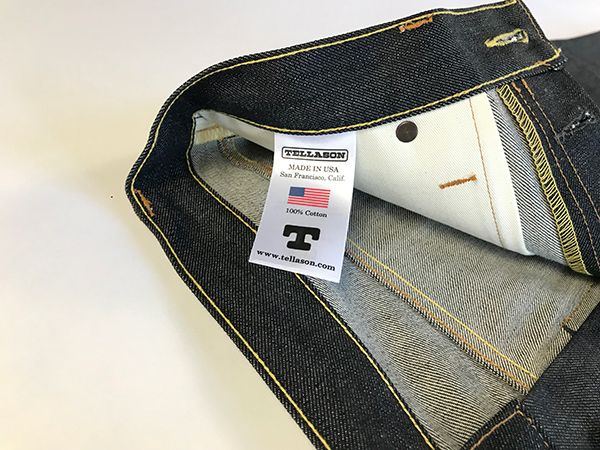
There is a reason Tellason planted itself in San Francisco and refuses to leave. The blue jean was born here, in eighteen seventy-three, when Levi Strauss and the Reno tailor Jacob Davis patented the riveted work pant. To make jeans in San Francisco is to make them where they started. The founders say it without hedging: they are committed to the city, and they will make their jeans here and only here, forever. They mean the little father-and-daughter factory south of Market, a few minutes from their office, where the same hands have sewn Tellason from the first run. “If we don’t give them business, these jobs go away,” Tony has said. Keeping the work close is not nostalgia for them; it is how they control a stitch count, and it is a choice about who gets paid.
That is the whole of the Tellason argument, and it is a modest one. They are not reviving a mill or rescuing a town. They are two friends who decided that a good pair of jeans should be made by people you can drive to, priced so a working person can buy them, and built to outlast the trend that produced them. The denim travels from Japan; the company never has.
John Graham Mellor, 16.5 oz.
The slim-straight jean the company was founded on, in its heaviest rigid selvedge, cut and sewn in San Francisco. The founding cut, for the buyer who wants the real Tellason and a long break-in.
Ladbroke Grove, 14.75 oz.
The slim-tapered cut, born from customers who tapered the original themselves. A touch lighter and trimmer through the leg, for anyone who wants a contemporary line.
Coverall Jacket, Selvedge
The house denim jacket, a quiet collector favorite in Kaihara selvedge with utility pockets and selvedge detailing. The piece to add once the jeans have won you over.
Go Further
The Bottom Line
Tellason is the small, durable version of the made-in-America case. No mill to rescue, no factory of its own, just two friends who decided a good jean should be made by people you can drive to and built to last. The cloth comes from Japan now, and they will tell you so. The hands have been in San Francisco since the first two hundred and forty pairs, and the founders intend to keep them there.