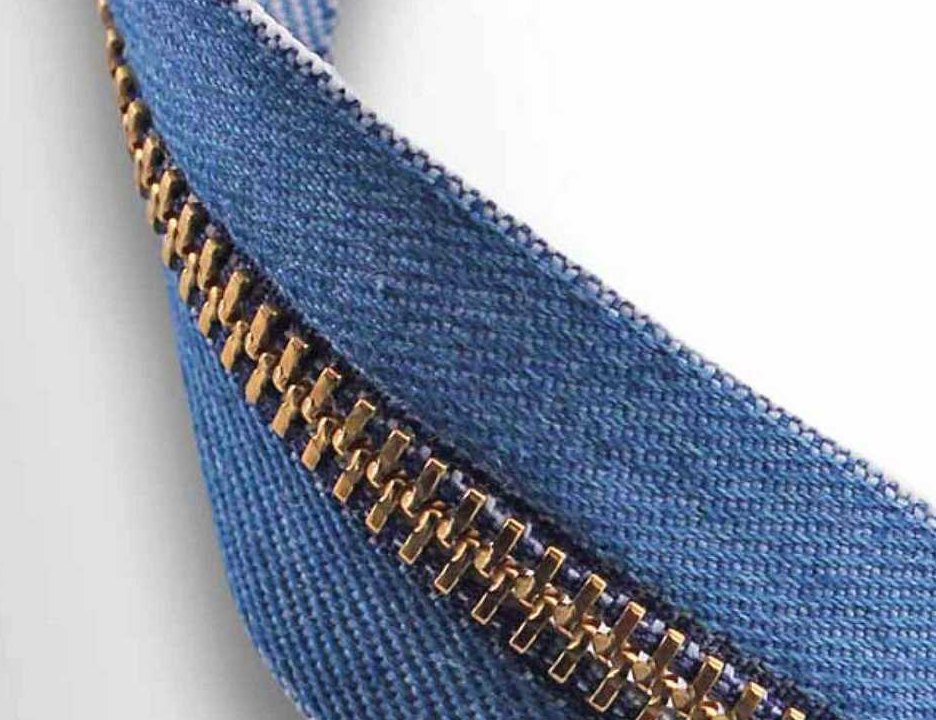
Two weeks ago this publication ran a profile of Scovill and ended it on a complaint: every brand will tell you the mill, the ounce weight and the sewing floor, and not one will tell you who made the hardware. It turns out that is not quite true. Freenote Cloth, profiled here in June, sells a raw selvedge jean called the Wilkes Western, and down at the bottom of its spec list, between the herringbone pocket bags and the size run, is a line that reads: US YKK zipper #5 from Georgia.
Those three letters are probably on something within reach of you right now. They are on jackets and luggage and tents and, very often, on the fly of your jeans. The company behind them makes roughly half the zippers in the world. What almost nobody knows is that the zipper is an American invention the United States let slip away, that the Japanese company that took it was started with a closeout lot of bad inventory, and that its first fully integrated plant outside Japan was built in middle Georgia, where it has been making zippers for fifty-two years.
The Invention Nobody Needed
The first working slide fastener was patented in May of eighteen ninety-three by Whitcomb Judson of Chicago, who called it a clasp locker and meant it for shoes, and showed it that year at the World’s Fair. It used hooks and eyes, it was hard to make, and it popped open. The version that actually worked came from a Swedish engineer named Gideon Sundback, who replaced the hooks with two rows of interlocking metal teeth and a slider, and patented his hookless fasteners in nineteen thirteen and nineteen seventeen. That is the zipper you are wearing.
A businessman named Lewis Walker took control of the company in nineteen oh six, renamed it the Hookless Fastener Company, and by November of nineteen thirteen had moved manufacturing to Meadville, Pennsylvania, turning out a thousand fasteners a day. Then almost nothing happened. Tailors and garment makers were perfectly happy with buttons and hooks, which were cheap and easy to replace, and twenty-five years passed between the first patent and the first real use, on rubber galoshes. In nineteen twenty-three B.F. Goodrich put the fastener on a boot and named it for the sound it made. The company became Talon in nineteen thirty-seven.
Once the zipper caught on, Talon owned it. Its best year, nineteen forty-one, brought thirty-one million dollars in sales. At its peak it employed five thousand people in a town of fewer than nineteen thousand. Into the nineteen sixties, seven of every ten zippers sold in the United States said Talon on the pull. Jeans were part of the conversion: Levi’s added a zipper fly partly to win over East Coast women who were thought to be wary of the button fly, and the zipper eventually won the argument almost everywhere outside the raw denim world.
A decade after the nineteen sixties, Talon had lost half its share of the American market.
A Clerk and a Closeout
Tadao Yoshida was born on the nineteenth of September, nineteen oh eight, in a village in Toyama Prefecture that is now part of the city of Uozu, on the Sea of Japan. As a boy he read a biography of Andrew Carnegie and never let go of one idea in it, that people with great wealth are obliged to use it to help others. At twenty he went to Tokyo and took a job at Furuya Shoten, a shop that imported Chinese ceramics. After the Manchurian Incident in nineteen thirty-one the ceramics trade dried up, and the shop tried to survive by selling zippers instead. It failed.
In January of nineteen thirty-four, twenty-five years old, Yoshida took over what was left, a stock of unsold zippers, and opened a small business in the Nihonbashi district of Tokyo called San-es Shokai to process and sell them. The product was terrible. By the accounts that survive, more than half the zippers on the Japanese market at the time were defective. Rather than keep reselling other people’s bad work, Yoshida started making his own, and built a metal plant to do it. That decision, to make the parts himself instead of buying them, is the entire company in miniature, and it has never changed.
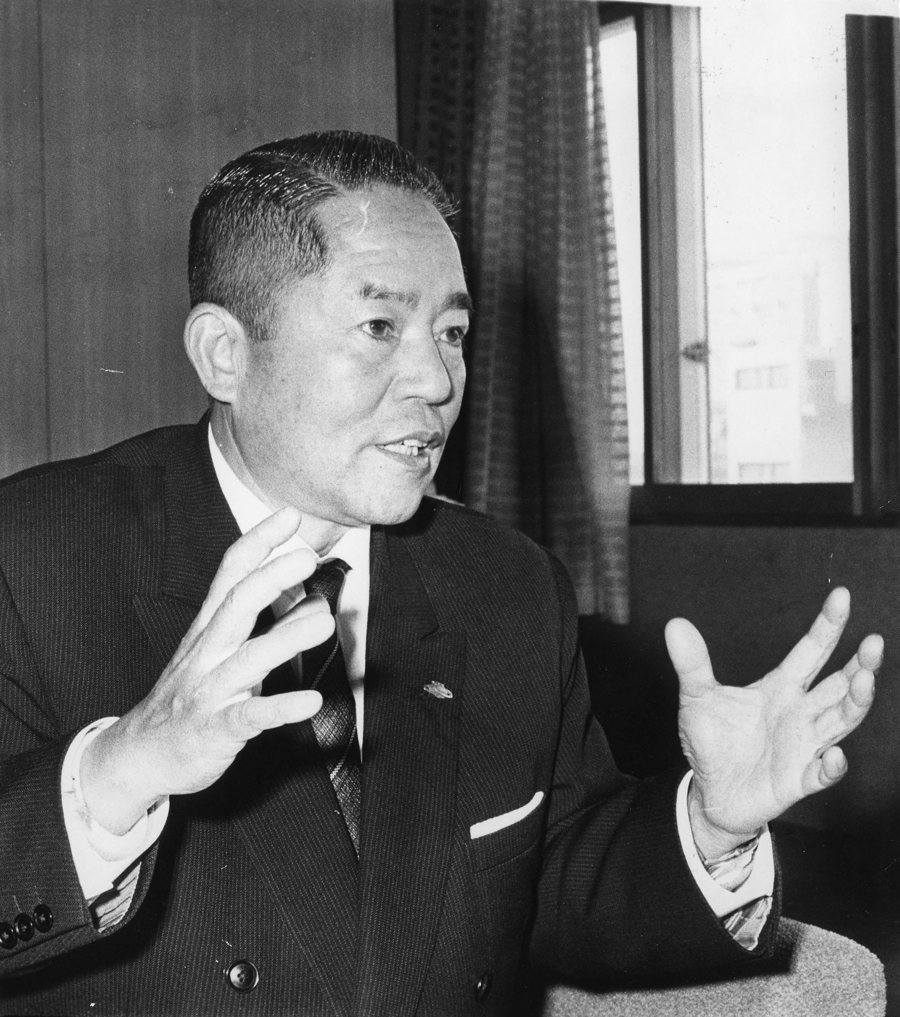
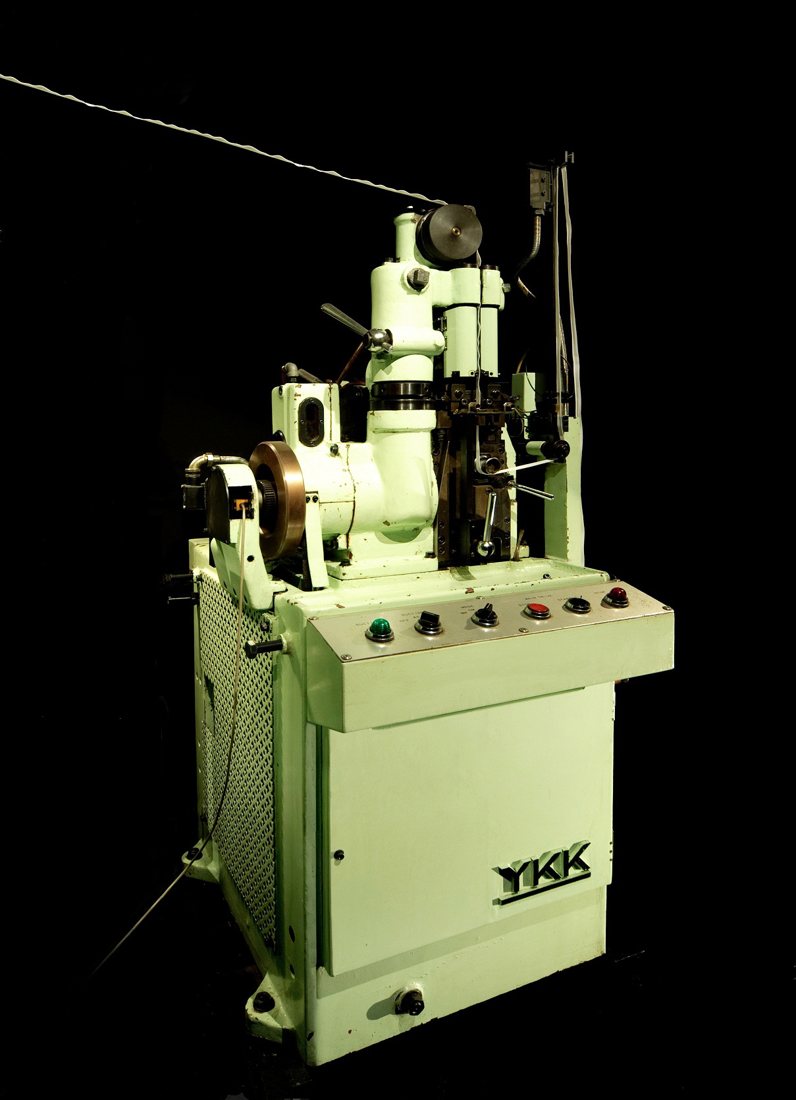
The war nearly ended it. Yoshida built a factory in Tokyo in nineteen thirty-eight, and in nineteen forty-five it was destroyed in the air raids. He started over that same year under a new name, Yoshida Kogyo Kabushiki Kaisha, Yoshida Manufacturing, and registered the three initials as a trademark in nineteen forty-six. In nineteen fifty he bought an American chain machine, which automated the process of setting teeth on tape that his workers had been doing largely by hand. It is reported that he borrowed heavily to buy a handful of them and then had copies built. What is certain is what came next. By nineteen fifty-three the company had developed its own chain machine, the CM6, and earned its first patent on it, and it has designed its own production machinery ever since. In May of nineteen fifty-five it opened a plant in Kurobe, near where Yoshida grew up, and Kurobe is still the center of the company.
Somewhere in those years he put the Carnegie idea into words, and it remains the guiding principle of the YKK Group today. He called it the Cycle of Goodness.
No one prospers unless he renders benefit to others.
Beating the Inventor
YKK arrived in the United States in nineteen sixty as a distributor, with an office near the garment district in New York. Its zippers were cheaper than Talon’s and at least as good. Talon, which had never really had to compete, did almost everything wrong in response. It did not invest enough in productivity, so its prices stayed high. It did not chase new uses in luggage and outdoor gear. It barely exported, even as the garment factories that were its customers began moving out of the country. YKK did the opposite on every count: it built its own machines, fed them its own alloys, and put factories near its customers wherever they went, beginning with plants abroad from nineteen fifty-nine and El Salvador in nineteen sixty-seven.
By the nineteen seventies YKK was the largest zipper maker in the world, and sometime in the nineteen eighties it passed Talon in Talon’s own country. Meadville paid for it. Through the late seventies and early eighties the town’s unemployment rate ran just under twenty percent, and Talon manufacturing there ended for good in nineteen ninety-three. That was the same year Tadao Yoshida died, of pneumonia, on the third of July, at eighty-four. His son Tadahiro took over the company.
The Governor Came to Check
Here is where the story stops being a Japanese story. When YKK went looking for a place to build its first integrated production plant outside Japan, the decision was clinched by a meeting. Cloyd Hall, a Macon native who worked as a special assistant to Governor Jimmy Carter, introduced Carter to Yoshida, and by the account YKK’s own American president gave at the fiftieth anniversary, the two men made an instant connection. The company bought fifty-four acres in Ocmulgee Park in nineteen seventy-two, broke ground in nineteen seventy-three, and started production in nineteen seventy-four with about fifty employees. It was the first Japanese manufacturer in Georgia.
Carter did not treat it as a ribbon cutting. According to 13WMAZ’s reporting, he had a hand in the project from the land purchase to the grand opening and would swing by the site to see how construction was going. The friendship lasted. Yoshida attended Carter’s inauguration in January of nineteen seventy-seven. The Yoshida family visited the Carters in Plains, and the Carters visited them in Kurobe and Tokyo. Engineers hired for the Macon plant, including a young man named Alex Gregory who would later run YKK’s whole American operation, were sent to Japan to learn the process. In nineteen seventy-seven, with YKK playing a pivotal role, Macon and Kurobe became sister cities, and more than eleven hundred people from the two towns have crossed the Pacific to visit each other since. YKK has long backed Macon’s Cherry Blossom Festival and gave three hundred thousand dollars toward the festival’s headquarters building.
Carter, speaking about YKK in a WPGA report, said the influence ran in both directions.
I was very heavily influenced not only in business affairs but also in governmental attitudes, by that cycle of goodness that Tadao Yoshida introduced.
A Zipper Plant That Makes Its Own Brass
What distinguishes YKK, and what distinguishes the Macon site in particular, is how far back down the chain it goes. Most apparel components are assembled from bought-in materials. YKK calls its model a total vertically integrated manufacturing system, and in Macon that starts with metal. At what the company calls its National Manufacturing Center foundry, copper and zinc are melted together in a furnace, cast into a ribbon, and hot-rolled into brass under heat and pressure. That brass is then either stamped in Macon into teeth, sliders and stops, or shipped to the company’s plant in Kentucky. The site kept growing for two decades: two hundred and fifty more acres at Chestney Park in nineteen seventy-nine, then textile, coil zipper and woven zipper plants and a cord and sewing thread plant between nineteen eighty-two and nineteen eighty-four, and a brass wire plant in nineteen eighty-eight.
The jean zipper is part of it. YKK states that it keeps a brass zipper manufacturing plant in Macon where the teeth for its YZiP jean zipper, a Y-shaped tooth designed to run more smoothly than a standard metal zipper, are developed. In November of two thousand nineteen the company announced it would start producing its recycled-tape Natulon zippers in Macon as well, including a YZiP on recycled tape made, in its words, for the North and Central American denim industry. That phrase is the honest shape of the business. Most American jeans are no longer sewn in America, and a zipper plant in Georgia now serves a denim industry that runs through Mexico and Central America as much as through Los Angeles or Chicago. The Macon plant has diversified to match, into automotive, government and medical work, and it employs more than six hundred people today.
It has also been tested. In July of nineteen ninety-four, Tropical Storm Alberto dropped days of rain on Georgia and the Ocmulgee River crested at Macon on the sixth of July at about thirty-five feet, the highest stage recorded there since eighteen eighty-seven. YKK’s own timeline records that its Macon plants came through the flood without missing a deadline.
The Button Company Talon Bought
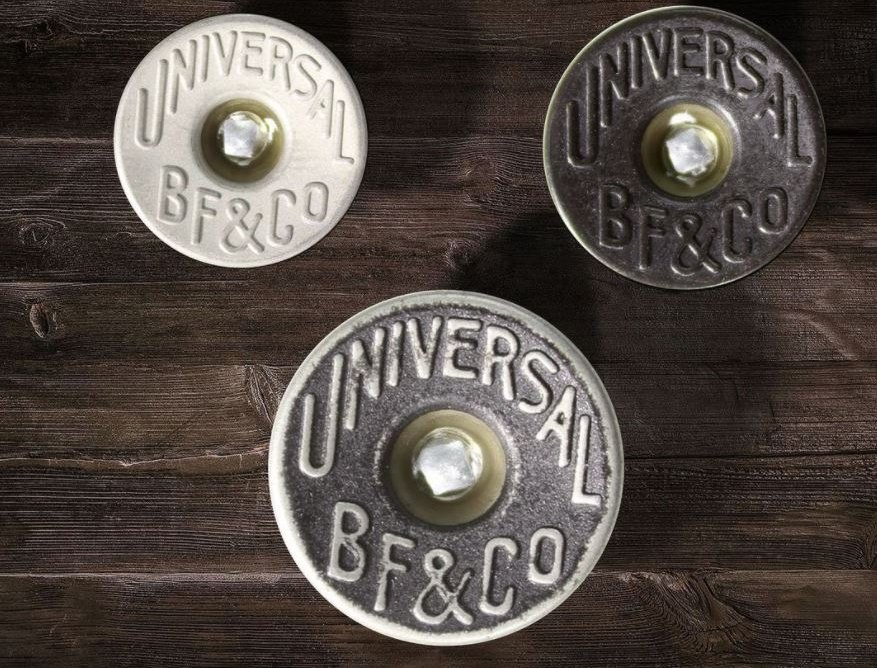
The second half of YKK’s American hardware story has the best twist in it. In eighteen ninety-five, in Detroit, a doctor named Howard Longyear and his brother John backed an inventor named Franklin McKenney, who spent three years developing a two-prong fastener that could be attached to fabric by machine, with no sewing and no pre-punched hole. It was patented in eighteen ninety-six, first for high-top shoes. The McKenney Button Fastening Company became the Universal Button Fastening and Button Company in nineteen oh five. After the Second World War it struggled, tried making zipper parts, and in doing so caught the eye of the biggest zipper maker in the country. In nineteen fifty-five Talon bought it, and the company moved to Lawrenceburg, Kentucky.
It went independent again in nineteen eighty-one and became Universal Fasteners in nineteen eighty-four. Then in nineteen eighty-seven, by which time YKK led the American zipper market, YKK bought it. The Japanese company that took the American zipper market away from Talon also ended up owning the American jeans button company Talon used to own, and kept it in Kentucky. It is now YKK (U.S.A.) Inc. Snap and Button Products, and the two-prong idea patented in Detroit in eighteen ninety-six is, in modified form, still how its snaps and jeans buttons are attached.
Lawrenceburg is also where the newest chapter is being written. In April of two thousand twenty-six YKK Americas joined the United States Footwear Manufacturers Association after entering the boot market by buying Collt’s Manufacturing. Its boot hardware division, headquartered in Lawrenceburg, makes metal eyelets, speed loops, buckles and zippers for boot makers including Belleville, McRae, Danner and Rocky, and for military footwear that has to meet the Berry Amendment’s domestic-content rules. Phillip Robider, who runs government and safety sales, said every boot maker he met was worried about supplier capacity. His answer was plain: the division is at one-third capacity and ready.
Where It Is Made
YKK is not a small American maker and should not be read as one. It is a Japanese multinational with roughly nine hundred and twenty billion yen in annual revenue, more than forty-five thousand employees, and something like forty to forty-five percent of the global zipper market. It operates through about a hundred subsidiaries in more than seventy countries, and a YKK pull on a jacket tells you nothing about where that particular zipper came from. It has also paid for its dominance in court: in two thousand seven the European Commission fined it one hundred and fifty million euros for fixing prices with Prym and Coats, a decision the company appealed and lost. And it is under real pressure, chiefly from a dozen or so consolidating Chinese makers, some of which openly mimic YKK, led by SBS, which is listed in Shenzhen and stands out for its size and patent filings.
What can be said about the American operation is specific. The brass is cast and rolled in Macon. Zippers have been made there since nineteen seventy-four, with dedicated textile and woven zipper plants since the early eighties. The jean zipper is made there. Jeans buttons and snaps are made in Lawrenceburg. And because both a jeans brand and the maker say so, at least one jean currently for sale can be traced by name to a Georgia-made YKK zipper, which is one more link in the American chain than this publication could document a month ago.
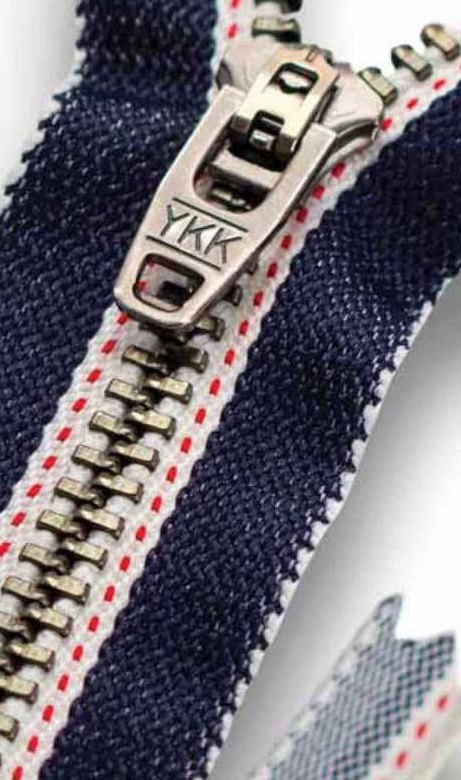
Freenote Cloth Wilkes Western, 13oz
A raw jean in natural indigo Japanese denim, sewn in the USA, with the zipper specified in the brand’s own words as a US YKK #5 from Georgia. The only jean we have found that traces its fly to a Georgia plant on the product page.
Railcar Fine Goods Chore Coat
Cut and sewn in Steven Dang’s own El Monte workshop from ten-ounce Candiani denim, and finished with Railcar-branded donut buttons that the listing identifies as made in the USA by YKK. A jacket built around exactly the hardware the Lawrenceburg plant makes.
Dearborn Denim High Rise Straight
A women’s straight leg in stretch denim, cut and sewn in Dearborn’s Chicago factory, listing its hardware as sourced in the USA: a Horween leather patch, a gold leaf button, and a YKK zipper. The price of a mall jean.
Go Further
The Bottom Line
YKK is the reindustrialization story told from the other side. America invented the zipper and let a Pennsylvania monopoly coast until it died, and one of the things keeping zipper manufacturing alive in the United States is a Japanese founder’s stubborn belief in making every part himself, planted in Georgia with a governor’s help. Fifty-two years on, the Macon plant still starts with copper and zinc, the Kentucky plant still sets buttons with an idea patented in Detroit, and for the first time in this publication a jean on sale today names the American state its hardware came from. That should not be rare. Every brand using American-made hardware could say so on the label, and the ones that do make the whole chain easier to see.