Ciano Farmer Denim Co. makes jeans, work shirts, jackets and waistcoats by hand in Denton, Texas, one garment at a time, on vintage Singer and Union Special sewing machines. Its cloth is a working history of American denim: Cone Mills selvedge from the shuttered White Oak plant, Mount Vernon Mills selvedge from Georgia, Japanese shuttle-loom denim, rolls pulled out of abandoned factories, and a small, irregular run of selvedge woven in Texas itself.
The Toaster and the Label
Asked once to explain what he was after, Farmer told a story about his grandmother’s toaster oven. It was a chrome General Electric, made in the United States, and when it broke, a repairman came to her house and replaced it for free. The lesson he took from it, as he told Voyage Dallas in two thousand nineteen, was that an American product was supposed to outlast its first problem, and that the company that sold it was supposed to stand behind it.
He spent his first career a long way from that idea. Texas Monthly reports that he was a creative director at Puma and vice president of design at Ecko Unltd., and Houston CityBook adds Fila to the list. In two thousand one, he started a denim label under his own first name. Those jeans were produced overseas, in Japan and China, and sold in stores in the United States and abroad. The brand was known for what it called a wood wash, and a sub-label, CSTAR, developed its own following.
Around two thousand ten, by his account, the business stopped making sense. Retailers wanted more product for less money and showed little interest in where it was made. Farmer’s phrase for it was “quantity over quality.” He closed the company.
“I never use new machines to make a pair of denim.” Ciano Farmer
A Loom in Beasley
The second brand began in Richmond, southwest of Houston, as a Kickstarter pitch: American selvedge, made one pair at a time, with a guarantee to repair it for life. One campaign to relaunch the name fell far short, raising about twenty-four hundred dollars against a sixteen-thousand-dollar goal, and Farmer promised to honor those pledges anyway. Another drew one hundred twenty-one backers and just under twenty-two thousand dollars. CityBook credits that money with rebooting his career in two thousand fourteen.
The crowdfunding produced something better than cash. After the campaign launched, a Texas man who ran a feed bag company offered to weave denim for him. The Denim Hound, which has written the most detailed account of the arrangement, identifies him as Mr. Williams, a former Cone Mills loom engineer who owned one of the original Draper looms from the White Oak plant and had moved it to Texas to weave feed bag fabric. CityBook’s version has Farmer buying his first denim from “a 70-year-old farmer who has a loom down in Beasley,” a small town in Fort Bend County.
The price of the cloth was partly social. CityBook reports that the weaver required Farmer to keep the jeans affordable for his fellow farmers. The Denim Hound adds that Williams’s farmer customers get a good deal and free repairs for life, that Farmer brings a bottle of Texas bourbon when he goes to pick up a roll, and that Williams’s wife puts a meal on the table. Farmer’s product pages still call him the legendary “old man Mr. Williams.”
The fabric behaves like what it is. Each lot is small and slightly different, with slubby yarn and a narrow width that eats more cloth per pair. One lot reviewed in two thousand twenty, a natural Texas denim, paired organic long-staple Texas cotton with a natural indigo warp and an undyed weft. The reviewer who soaked it found that it shrank about twice as much as expected, and Farmer admitted the fabric is hard to predict.
Twelve Machines for One Pair
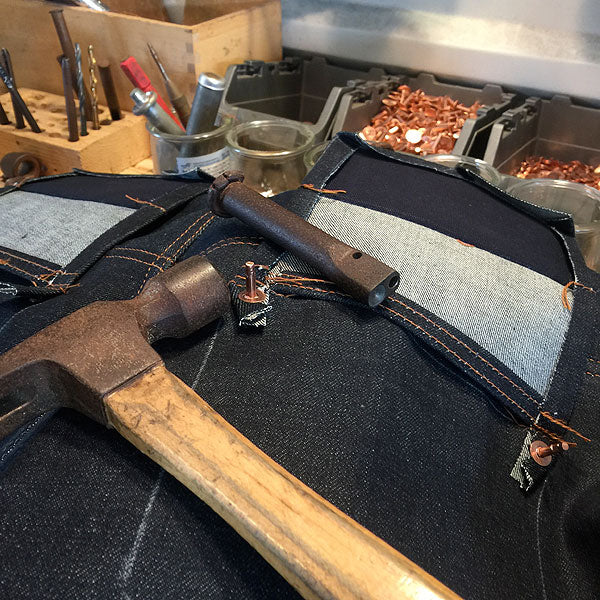
The method never scaled, and it was never meant to. Farmer traces a worn paper pattern onto the cloth with tailor’s chalk and cuts it with vintage scissors. A pair passes through twelve to fifteen vintage machines, against five or six on a modern line. Those machines have no backstitch, so he ties off threads by hand. He sets copper rivets with a hammer, stamps each pair with its birth date, and keeps a record of it for future repairs.
The word spread through the people who care most about such things. Texas Monthly credits his friend Clint Wilkinson, a Denton leather maker who works out of his grandfather’s old saddle shop, with talking him into Texas, and the workshop is now in Denton, open to the public on Saturday afternoons. Texas Monthly put him in its holiday gift guide in two thousand eighteen. In two thousand twenty, the George W. Bush Presidential Center asked him for face masks, and he sent over a design in nineteen sixty-eight Cone selvedge and duck canvas. Texas Monthly counts Post Malone and Matthew McConaughey among his clients, alongside the ranchers in its headline.
The cloth wall became the real collection. He once had four yards of nineteen seventies natural Cone selvedge and cut them for one customer. A nineteen sixties broken twill came out of an abandoned Oklahoma factory that had made workwear and military uniforms; one edge was damaged after sixty years on the floor, so he built the jeans with a half selvedge, the way Lee did in the nineteen fifties. And since White Oak’s closure sent so much of the Draper fleet to Georgia, he has added lots of indigo selvedge from Mount Vernon Mills, along with its duck canvas and chambray, which carry many of his jackets and shirts.
“It’s also the only way to do it right.” Ciano Farmer Denim Co.
One Man, Six Months
The hard part of this business is arithmetic. Farmer told Voyage Dallas in two thousand nineteen that he ran the shop alone and struggled to fill custom orders on time, and that hiring help would really mean taking on an apprentice, since the work has fallen out of the industry. He has brought in fashion students from the University of North Texas as interns. By late two thousand twenty-five the wait for a made-to-order pair had reached six to eight months.
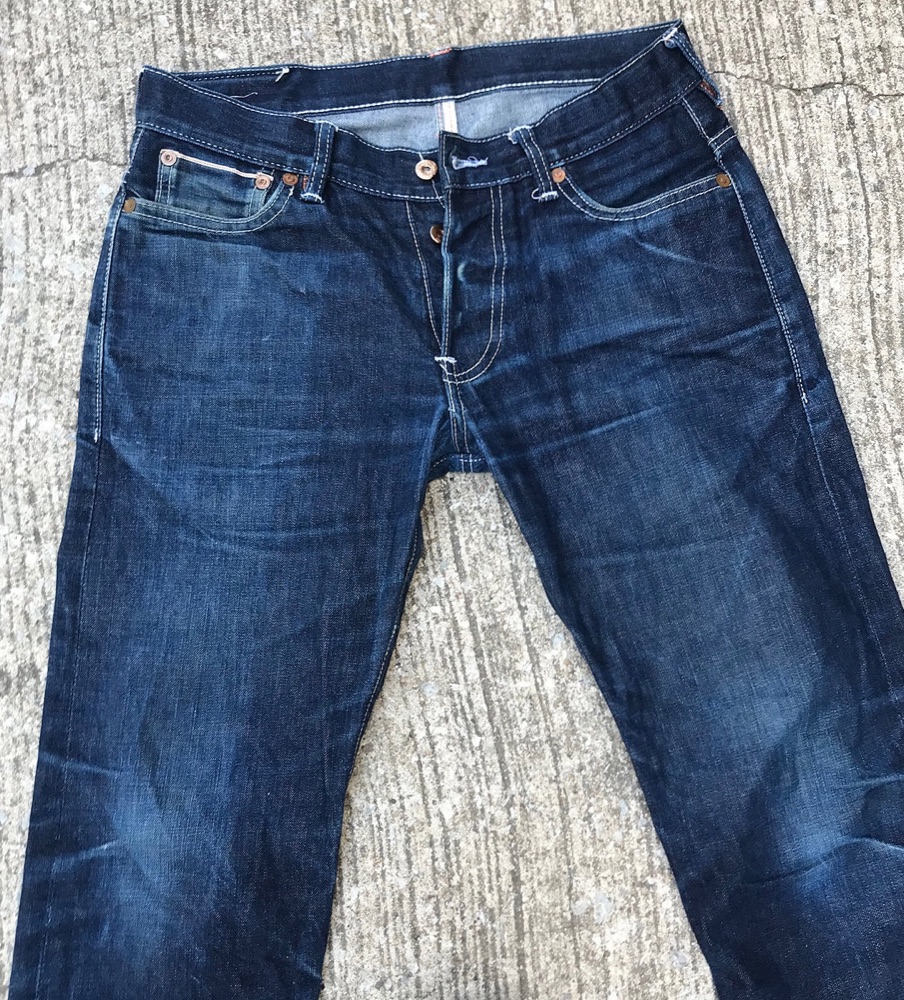
The answer has been to sell differently without working differently. The shop now offers what it calls Open Stock, small batches announced by email and hemmed to the buyer’s inseam before shipping, alongside the custom orders that made its name. Each cut is sold under a plain model number: the 901 slim, the 905 regular and the 997 miner fit. The lifetime guarantee remains, and it is a real liability for a one-person shop, since every pair sold is a pair that may come back. The photograph at the top of this page is one that did.
Feed Sacks and Fort Bend
Texas grows more cotton than any other state, and very little of it is woven into denim at home. Farmer’s Texas denim is a very small exception, and its origin is wonderfully unglamorous. The Draper shuttle loom, once the machine that filled White Oak with selvedge for Levi’s, survives here as equipment for a farm supply business and turned to denim because its owner happened to see a Kickstarter.
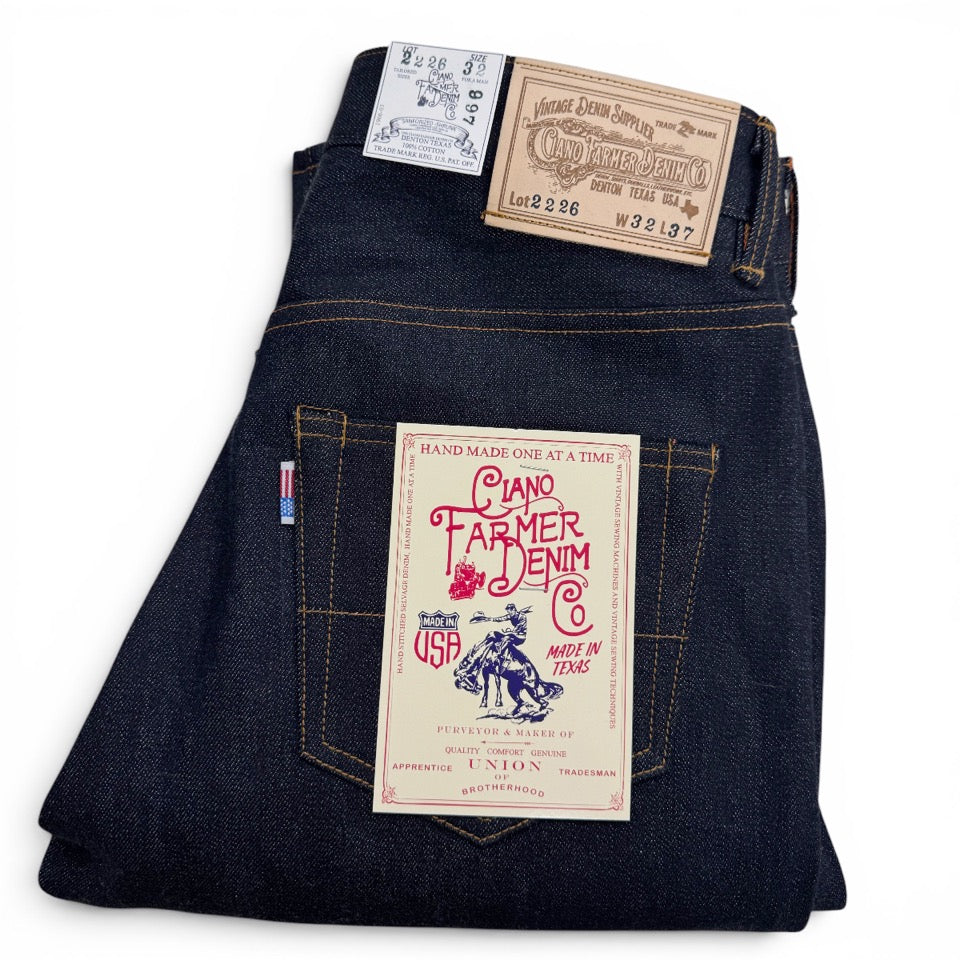
The shop’s look reaches back as well. Waistcoats replicate a vintage buckle; jackets follow the Type II and the nineteen sixty-seven Type III; a canvas pea coat borrows from the Navy. The flasher on the back pocket reads like an old union hall poster, with a bronc rider and the words “Apprentice,” “Tradesman” and “Union of Brotherhood.” The sentiment is the same as the toaster’s. Something made here ought to be fixed here.
#TEX 13.5oz Texas Selvedge, 901 Slim
The feed bag loom jean. Slubby, heavy-bleeding, limited by lot, and sanforized, though past lots have shrunk more than that word suggests. Buy for what the cloth is and allow for some unpredictability.
1960s Deadstock Broken Twill, 905 Regular
Fifteen-ounce American selvedge rescued from an abandoned Oklahoma factory and built with a half selvedge. Already made and hemmed to your inseam, so there is no six-month wait, and it is the least expensive jean here.
Mount Vernon Chambray Work Shirt
Five-ounce chambray woven by Mount Vernon Mills and sewn in Denton with the same construction as the jeans. An easier way into the shop’s work if you already own jeans you love.
Go Further
The Bottom Line
Ciano Farmer Denim Co. is what is left when someone who knows exactly how the volume business works decides to do the opposite. A former sportswear designer cuts and sews jeans in Denton, one pair at a time, on machines older than he is, from American selvedge old and new, some of it woven on a loom that also makes feed bags. The wait is long and the cloth can be unruly. He will fix them for as long as you own them.